TOTAL VOLUME:
$133.6b
24H VOL:
$92,851,721
24H TRANSACTIONS:
2,371,557,760
OPEN INTEREST:
$1,376,165,751
370,286
Markets across
29,142
events
MATCHED EVENTS:
2,555
PLATFORM COVERAGE:
5
Polymarket:
40%
VS.
Kalshi:
60%
What Happens When a Prediction Market Event Gets Cancelled
A cancelled or postponed event doesn't reliably mean a refund: Kalshi settles at the last traded price, Polymarket's rare fallback is a 50/50 split.

Jared Polites
Sep 24, 2026
TL;DR
- A cancelled or postponed event does not reliably mean a refund. Kalshi's rulebook settles the contract at its last traded price, or through a formal Outcome Review Committee ruling, and neither one returns what you paid.
- Polymarket's documented fallback for a genuinely unresolvable event is a 50/50 split between Yes and No, not a refund, and Polymarket's own rules call it a rare, last-resort outcome reached only after two rounds of disputes.
- Limitless is the platform with an actual refund-at-cost policy for "misresolved" markets, including cancellations, but only when the specific market's own rules didn't already define what a cancellation means.
- Predict.Fun and Opinion don't publish a general cancellation policy, so the only answer that actually holds up anywhere is whatever the individual contract's resolution rules say, checked before you trade, not after.
Watched a game get rained out, or a vote get delayed, while you were still holding a position on it? The natural assumption is that the platform just hands your money back. On most of the platforms PredictionHero tracks, that assumption doesn't hold up.
A cancelled or postponed event does not reliably mean a refund. Kalshi's own rulebook settles the contract at its last traded price, or through a formal committee ruling, and neither path returns your original stake. Polymarket's documented fallback for an unresolvable event is a 50/50 split between Yes and No, also not a refund, though Polymarket itself calls this a rare, last-resort outcome. Limitless is the one platform with an actual policy that refunds your bet amount, and even that only applies when the market's own rules didn't already cover the cancellation scenario. The only answer you can actually rely on is whatever the specific contract's resolution rules say, and that's worth reading before you take the position, not after the event goes sideways.
Why Do People Assume a Cancelled Event Means a Refund?
The instinct comes from sportsbooks. Bet on a game that gets postponed through a traditional sportsbook, and the standard practice is to void the wager and return the stake, no winner, no loser, money back.
Prediction markets borrow the word "void" but not always the mechanic behind it. Each of the five platforms PredictionHero covers built its own resolution process, on different technical foundations (a CFTC-regulated rulebook, a decentralized oracle, on-chain dispute systems), and "the event didn't happen as scheduled" resolves differently depending on which one you're on, and often depending on what that specific market's own rules already say.
How Does Each Platform Actually Handle a Cancelled or Postponed Event?
| Platform | What actually happens | Refund of what you paid? |
|---|---|---|
| Kalshi | Expiration date can be pushed back first (Rule 7.2(b)); if still unresolved, settles at the last traded price or a committee-determined "fair allocation" (Rule 6.3(c)) | No |
| Polymarket | Per-market rules usually cover it directly; rare unresolvable cases escalate through two dispute rounds to a 50/50 split | No, aside from a narrow rules-clarification refund for trades placed before the clarification |
| Limitless | A "misresolved" market (criteria that can't be applied to what happened, including a cancelled event) refunds the bet amount, if the market's own rules didn't already define the outcome | Yes, conditionally |
| Predict.Fun | Not publicly documented; resolves via UMA's optimistic oracle like Polymarket, so a similar dispute structure is plausible but unconfirmed | Not publicly documented |
| Opinion | Not publicly documented; resolution is defined per market via its "Opinion AI" process rather than a general platform policy | Not publicly documented |
What Does Kalshi Do When an Event Is Cancelled or Rescheduled?
Kalshi's rulebook handles this in two steps. Under Rule 7.2(b), if the event a contract depends on is rescheduled or cancelled in a way that would keep Kalshi from determining the outcome accurately, Kalshi can adjust the contract's expiration date and timing. A postponed game or a delayed vote often just pushes the contract's clock first, not its outcome.
If the event still can't be determined after that, Rule 6.3(c) takes over. Kalshi settles using the contract's last traded price, if one is available and represents a fair settlement. If not, the Outcome Review Committee makes a binding "fair allocation" determination, and the rulebook states plainly that these committee rulings are final and not subject to review.
Neither path is a refund. Say you paid $0.65 for a Yes contract that last traded at $0.20 before the underlying event was scrapped. You get $0.20 per contract, not your $0.65 back and not $0.
Separately, Kalshi's rulebook does include a genuine refund mechanism, canceling a contract and returning the funds paid to enter trades, but it sits under the exchange's emergency powers (natural disasters, system failures, and similarly extraordinary circumstances), not under the routine handling of a postponed game.
What Does Polymarket Do When an Event Doesn't Happen?
Most Polymarket markets resolve through an unopposed proposal within a couple of hours, or after a single round of dispute. Every market also carries its own written "edge case" rules, which frequently spell out in advance what happens if the underlying event is postponed or doesn't occur, so a proposer can settle accordingly without ever touching a fallback mechanism.
The 50/50 outcome only shows up after a resolution proposal is disputed, a second proposal is made, and that gets disputed too, escalating to a vote among UMA token holders. If that vote lands on "none of the other options are appropriate," every share, Yes and No, redeems for $0.50. Polymarket's own documentation describes this outcome as rare, not the default response to a rained-out game or a scrapped vote.
It's also not a refund. A $0.50 payout on a share you paid $0.80 for is still a loss, just a smaller one than a straight No would be.
What Does Limitless Do When a Market Can't Be Resolved as Written?
Limitless documents a distinct "misresolved" category: a market whose published criteria are ambiguous, or can't be applied to what actually happened. Its guidance separately notes that an individual market's own rules can define how edge cases like a cancelled game get handled, the same way a bracket-style market might spell out what happens on a tie.
When a market is misresolved, Limitless refunds the bet amount, not a $1 payout and not a $0 loss. That refund isn't the default for every cancellation, though. If a specific market's own rules already define an outcome for a cancelled event, that written language controls instead of the misresolved fallback. The refund path applies when the market's rules are silent on the scenario, or don't cover what actually happened.
What About Predict.Fun and Opinion?
Neither platform publishes a general cancellation or void policy. Predict.Fun resolves markets through UMA's optimistic oracle, the same family Polymarket uses, which makes a similar dispute-and-fallback structure plausible. That's an inference from its resolution mechanism, though, not something stated outright in Predict.Fun's own documentation.
Opinion resolves each market against its own stated data source, run through what it calls "Opinion AI," with resolution details published per market rather than as a platform-wide rule. If you're holding a position on either platform when an event gets cancelled or postponed, the specific market's own rules are the only place to check. There's no general company policy to fall back on.
Why Doesn't "Voided" Mean the Same Thing Everywhere?
Five platforms, five different answers to the same question, isn't a sign that any one of them is doing it wrong. It's a byproduct of a still-young industry building out its resolution infrastructure on different foundations at different speeds.
Kalshi operates under direct CFTC oversight with a filed rulebook and a named committee of record. Polymarket and Predict.Fun lean on a decentralized oracle with a public dispute process. Limitless and Opinion each wrote their own resolution logic from scratch. Every one of those approaches is solving the same underlying problem, what to do when reality doesn't cooperate with the contract's wording, and each has converged on a different tradeoff between speed, discretion, and cost.
Why Does the Contract's Rule Text Matter More Than the Headline Event?
A market titled "will the Fed cut rates at the March meeting" is really asking about one specific meeting on one specific date. If that meeting gets rescheduled, what happens next depends entirely on how that contract defined "the March meeting," and every platform (and often every individual market) writes that definition slightly differently.
The same real-world news event can trigger a grace-period extension on one contract, a last-price settlement on another, and a documented refund on a third, even when all three are nominally "the same bet." Checking the resolution rules before you take a position is the only way to know which outcome actually applies to the contract in front of you, rather than assuming it matches whatever a different platform, or a different market, does.
What Should You Do When Your Position Is in Limbo?
Until a platform actually marks a market as under review, misresolved, or voided, your contract is generally still live. If there's still a functioning order book, you can typically exit the position rather than wait out the uncertainty, on any of the five platforms.
Three things determine what happens next: the contract's stated resolution deadline, whether the platform has flagged the market yet, and whether the underlying source (a sports league, an election authority, a court docket, an economic data release) has issued a final status. Resolution timelines already vary enormously by platform and event type. A cancellation or postponement only stretches that further.
Delayed elections are a useful case study here, since the gap between "the news called it" and "the market actually settled" already runs longer than most traders expect even without a cancellation in the mix. Rules committees generally move faster on high-profile markets than obscure ones, so a market can sit unresolved for days after an event's fate is already public knowledge.
Ready to see how a live market is actually pricing right now? Compare Polymarket, Kalshi, Limitless, Predict.Fun, and Opinion on PredictionHero.
No. Only Limitless has a documented refund-at-cost policy for cancellations, and even that applies only when the specific market's own rules don't already cover the scenario. Kalshi settles at the last traded price or a committee ruling, and Polymarket's rare fallback is a 50/50 split, neither of which returns your original stake.
It depends entirely on the specific contract's stated resolution date and rules, not on a single platform-wide policy. Some contracts build in a grace period that lets the market wait for a rescheduled date; if the delay runs past that window, the outcome follows whichever settlement mechanism that platform and market use for an unresolvable result.
It depends on how the contract defined "resolve." A market asking whether a defendant is "found guilty" typically has no verdict to point to after a dismissal and falls to whatever fallback mechanism that platform uses for an unresolvable outcome. A market asking whether a case "concludes by a certain date" might resolve normally, since a dismissal is itself a conclusion.
It depends which platform. Limitless refunds the bet amount when a market is misresolved and its own rules don't already cover the scenario. Kalshi and Polymarket use mechanisms, last-price settlement, committee rulings, or a rare 50/50 split, that generally don't return what you originally paid.
Yes, on some platforms. Kalshi's Outcome Review Committee can revisit a determination, and Polymarket's dispute process allows a proposed outcome to be challenged before it's final. Check the specific platform's own rules for how long that window stays open before treating any status as final.
Sources
- Kalshi. "DCM Rulebook," Rule 6.3 (Settlement) and Rule 7.2 (Contract Modifications). kalshi.com/regulatory/rulebook
- Polymarket. "Resolution." docs.polymarket.com
- Polymarket Help Center. "How Are Markets Disputed?" help.polymarket.com
- Limitless. "Market Resolution" and "Refund Policy." docs.limitless.exchange
PredictionHero aggregates publicly available prediction market data for informational purposes only. This is not financial advice. Prediction markets may not be available in all jurisdictions.
Related
How to Read Prediction Market Rules Before You Trust the Price
Two platforms can price the same event five points apart, not because traders disagree, but because the contracts ask slightly different questions. Read the wording before you read the price.
Jared Polites · Sep 10
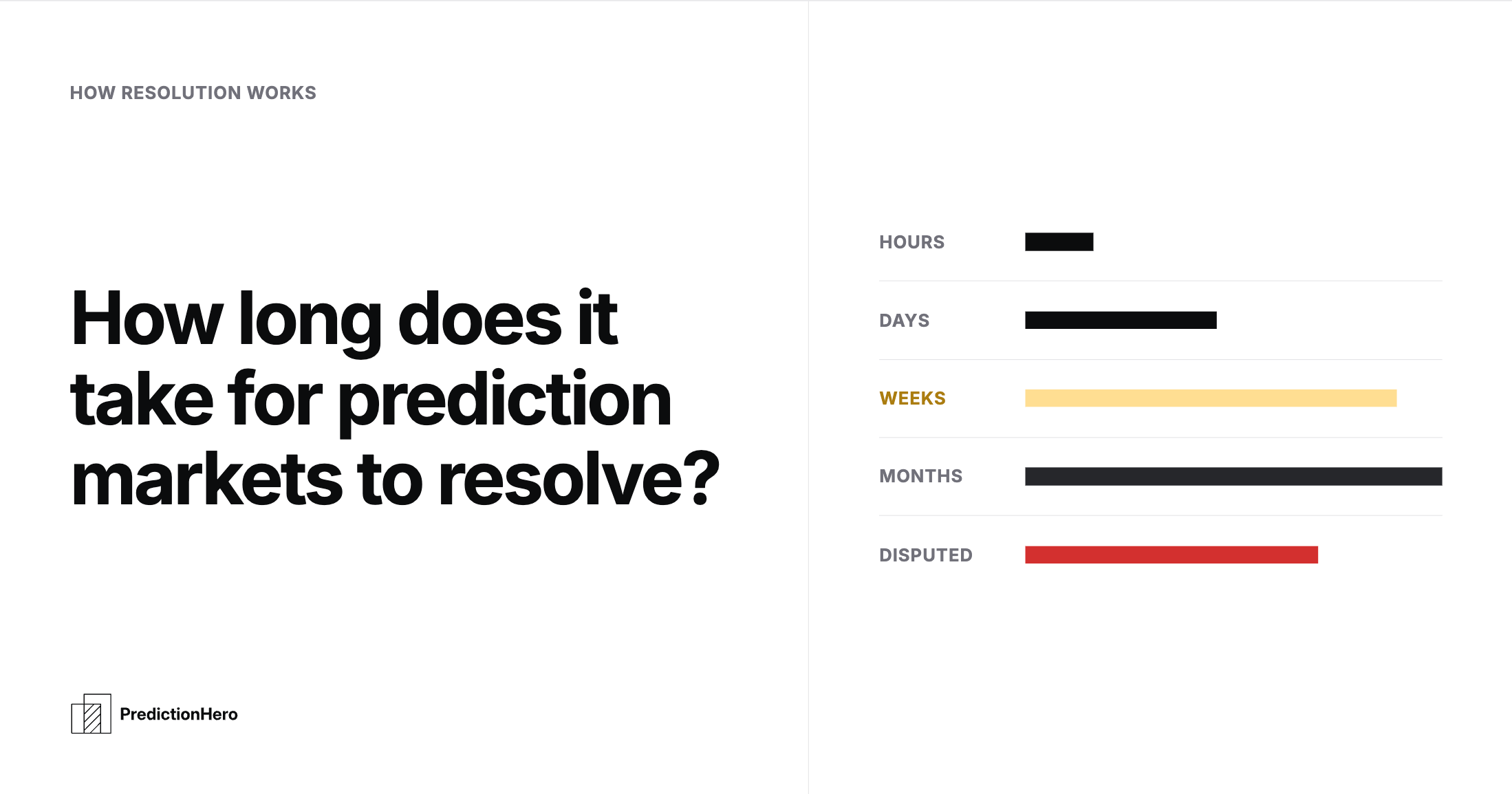
How Long Does It Take for Prediction Markets to Resolve?
Resolution speed depends on governance, not software. Kalshi confirmed a real Fed decision in eight minutes; Polymarket's identical contract took two hours because its dispute window ran uncontested.
Jared Polites · Aug 5
Why an Election Prediction Market Can Stay Open After the News Calls the Race
A contract doesn't pay out when CNN calls it. It pays out when the specific event named in its resolution criteria actually happens, and that gap can run days or weeks past election night.
Jared Polites · Aug 29