TOTAL VOLUME:
$140.7b
24H VOL:
$152,035,205
24H TRANSACTIONS:
2,543,053,589
OPEN INTEREST:
$1,594,903,066
424,369
Markets across
33,316
events
MATCHED EVENTS:
2,845
PLATFORM COVERAGE:
5
Polymarket:
39%
VS.
Kalshi:
61%
How Do Prediction Market Fees Actually Work?
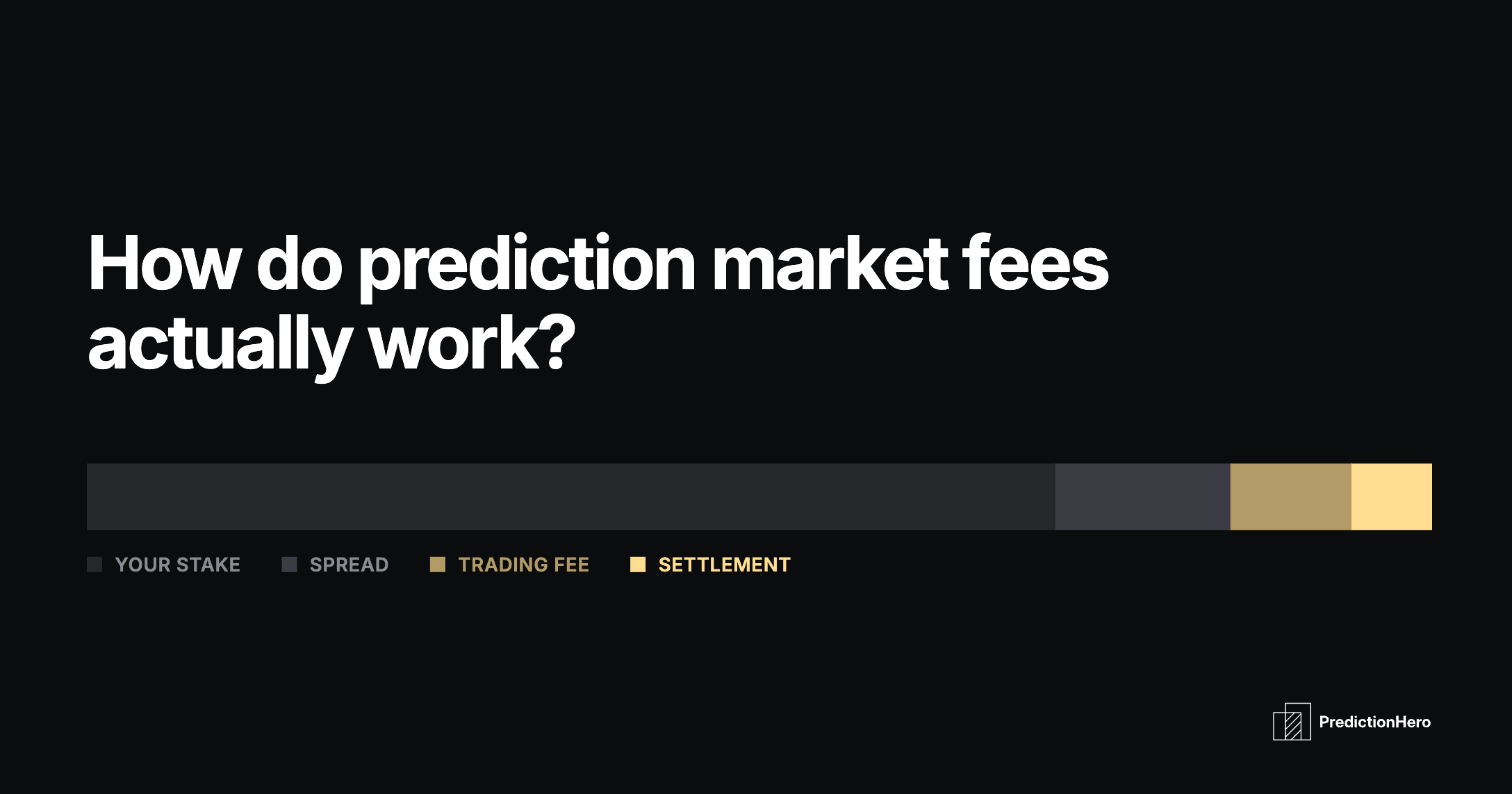
Kalshi, Polymarket, Predict.Fun, and Opinion now all charge takers a fee that peaks on a 50-cent contract and fades toward the extremes.

Jared Polites
Aug 18, 2026
TL;DR
- Kalshi, Polymarket, Predict.Fun, and Opinion all charge takers a fee shaped like a curve that peaks on a 50-cent contract and fades to nearly nothing near the extremes. Makers pay $0 on all four.
- On a 100-contract trade at 50 cents, Kalshi's taker fee runs $1.75. Polymarket charges that identical $1.75 on crypto markets, but only $1.00 on politics, finance, and tech markets, and nothing at all on its geopolitics markets.
- Predict.Fun's taker fee peaks at $1.00 per 100 shares at that same 50-cent mark. Its collateral also earns yield through Venus Protocol while a position stays open, and Predict.Fun keeps a 10% cut of that yield.
- Limitless is the outlier: its order-book taker fee runs 0.40% to 3.00% on the buy side and 0.42% to 1.50% on the sell side, with a flat 0.40% option on its automated market maker instead.
Ever bought into a contract at 50 cents and watched your actual fill land a cent or two worse than the price on the screen? That gap is usually the fee, and on four of the five platforms PredictionHero tracks, that fee follows the exact same shape.
Polymarket, Kalshi, Predict.Fun, and Opinion each take a cut from takers using a formula built around price times one minus price, which peaks at 50 cents and drops toward zero near 1 cent or 99 cents.
Makers, the traders whose orders sit and wait on the book instead of matching instantly, pay nothing on any of the four. Limitless is the exception: it prices its taker fee directly off which side of the trade you're on, running 0.40% to 3.00%, with a flat 0.40% option on its automated markets instead.
Why Does Fee Structure Matter More Than a Single Number?
A prediction market contract pays $1 if it resolves correctly and $0 if it doesn't. The two sides of a binary market sum to roughly $1.00 before fees. Every cent taken out in fees comes directly out of your potential payout, not out of some abstract house edge.
A sportsbook sets its own odds and bakes its margin directly into them. A prediction market's price comes from traders competing against each other instead, so the platform has to extract its cut a different way: a per-contract fee, a spread, a withdrawal charge, or a cut of interest earned on collateral. If you're new to that mechanic entirely, our prediction markets explainer covers how a contract's price maps to a probability before you get into fee math.
That's why "what are the fees" is the wrong first question. The right one is where a platform actually takes its cut, and whether that structure fits how you trade. A fee that peaks at 50 cents barely touches a 5-cent longshot and bites hardest on a coin-flip contract.
This comparison draws on each platform's own current fee documentation, checked today, August 18, 2026: Polymarket's and Opinion's Help Center and docs pages, Kalshi's Help Center and its published fee schedule, and Limitless's own docs. Predict.Fun doesn't publish one consolidated fee page, so its numbers below come from several independent trackers that agree on the same formula, all cited in Sources.
What Are Polymarket's Trading Fees?
Polymarket used to be the platform you'd point to as fee-free. That's no longer accurate. Polymarket now charges takers a fee on most markets: the fee equals the number of contracts times a category-specific rate times price times one minus price.
The rate depends on what you're trading. Crypto markets carry the highest rate, 7%. Sports, economics, culture, weather, and other general markets sit at 5%. Politics, finance, tech, and mentions run the lowest active rate, 4%. Geopolitical and world-event markets carry no fee at all, by Polymarket's own design.
Makers pay $0 on every category. Any order that rests on the book instead of matching instantly counts as a maker order, and Polymarket also runs a Liquidity Rewards Program that pays makers directly for keeping orders near the market price, on top of charging them nothing.
There's still no explicit charge to deposit or withdraw USDC, though an intermediary like Coinbase or MoonPay can charge its own conversion fee. What hasn't changed is the spread. On a thin market, the gap between the best bid and best ask still adds a real cost on top of the explicit fee, one that shows up nowhere on a fee schedule.
What Are Kalshi's Trading Fees?
Kalshi's fee has always been explicit, and the mechanic is what actually matters. The taker fee runs about 7% of a contract's expected value, calculated as price times one minus price and rounded up to the next cent.
At a 50-cent contract, that formula peaks: 0.07 times 0.50 times 0.50 works out to 1.75 cents per contract, or $1.75 on a 100-contract trade. Move to a 10-cent contract and the same formula drops to roughly 0.63 cents per contract, about a third of the cost.
The logic tracks risk. A 50-cent contract represents the most contested outcome on the board, so more capital changes hands there. A 3-cent contract is a longshot nobody is fighting hard over, so the fee shrinks to almost nothing.
Maker orders cost 25% of the taker rate on the same contract, per Kalshi's own fee schedule, not the full amount. There's no separate settlement fee and no membership fee, and ACH transfers in and out carry no charge either. Our Kalshi review covers its CFTC-regulated status and broader trust signals in more depth. Kalshi publishes its full, current fee schedule if you want exact numbers for a specific contract before you trade it.
How Do Limitless, Predict.Fun, and Opinion Handle Fees?
Limitless, Predict.Fun, and Opinion round out the five platforms PredictionHero tracks, and each treats fees differently from the other two.
Limitless breaks from the price times one minus price pattern the other four share. Its automated market maker charges a flat 0.40% fee on every trade, regardless of price. Its order-book markets charge takers separately: 0.40% to 3.00% on the buy side and 0.42% to 1.50% on the sell side, both scaling with where the contract sits. Resting limit orders, the maker side, trade free either way. Limitless runs on Base, so a small network gas cost sits on top of whichever fee applies.
Predict.Fun's taker fee follows the familiar curve, peaking at roughly $1.00 per 100 shares on a 50-cent contract and shrinking toward the edges. Makers pay nothing and collect a rebate worth 25% of the taker fee on every order they fill. Its real differentiator sits outside the fee schedule entirely: collateral backing an open position on Predict.Fun earns yield through Venus Protocol for as long as the position stays open, claimable weekly. Predict.Fun keeps a 10% cut of that yield, a cost that shows up on no standard fee comparison but still comes out of a trader's return.
Opinion runs the same taker-pays, maker-free model, with a fee equal to a topic-specific rate times price times one minus price, landing generally between 0% and 1% of a trade's notional value. A $0.25 minimum fee and a $5 minimum order size both apply. Opinion doesn't publish the exact rate for every topic alongside the base formula, so the effective fee on a specific macro contract, a Fed decision or a CPI print, falls somewhere in that band rather than at one fixed number. Opinion covers the on-chain gas cost of matching and settling trades itself, a real structural advantage for a platform built around macro releases that can see a burst of volume the second a data print hits.
What Does a Real Fee Comparison Look Like on the Same Contract?
Formulas are one thing. Actual dollars are another. Here's what a 100-contract taker trade costs on the platforms that publish an exact formula, at two different prices.
| Platform (taker fee) | At a 50-cent contract | At a 10-cent contract |
|---|---|---|
| Kalshi | $1.75 | $0.63 |
| Polymarket, politics/finance/tech | $1.00 | $0.36 |
| Polymarket, crypto | $1.75 | $0.63 |
| Predict.Fun | $1.00 | $0.20 |
| Opinion (0%-1% band, $0.25 min) | up to $0.50 | $0.25 |
| Limitless, AMM (flat rate) | $0.20 | $0.20 |
Two things stand out. On a crypto contract specifically, Polymarket's 7% rate matches Kalshi's formula exactly, at every price point, not just the ones in this table. On a politics contract, the identical trade costs 43% less on Polymarket than on Kalshi, purely from the category rate, before either platform's spread even enters the picture.
None of this accounts for spread. A market with a 2-cent gap between the best bid and best ask adds that cost on top of whichever fee applies, on every platform in this table, not just the ones with the lower headline rate. Our Kalshi vs. Polymarket comparison breaks down the two platforms beyond fees alone, on custody, regulation, and dispute handling.
Why Do Fees and Liquidity Trip Up Traders Who Only Compare Headline Rates?
A platform's fee schedule is only half the real cost of a trade. Liquidity, how easily you can get in or out without moving the price, is the other half, and it doesn't show up on any fee page.
A deep, heavily traded market has a tight spread, sometimes a fraction of a cent between the best bid and ask. A thin market can move several cents on a single position of real size, and that slippage functions exactly like a fee even though no platform labels it one.
That's why the platform with the lowest rate on a given category isn't automatically the cheapest place to actually put on a position. A Polymarket politics contract at a 4% rate can still cost more round-trip than a Kalshi contract at 7%, if the Kalshi market is deep and the Polymarket one is thin. Our breakdown of volume and liquidity covers why a big volume number doesn't guarantee a tight spread today.
This is the real reason to check pricing across all five platforms before entering a position, not just to compare fee schedules. A contract priced at 30% on one platform and 34% on another reflects a mix of fee structure, liquidity, and a different trader base pricing the same real-world event, not a math error on someone's part.
Frequently asked questions
Yes. Polymarket now charges takers a fee on most markets, from 4% to 7% of a contract's expected value depending on category, calculated as contracts times the category rate times price times one minus price. Makers pay $0, and geopolitical and world-event markets stay fee-free.
Kalshi's taker fee equals about 7% of a contract's expected value, rounded up to the next cent. That works out to roughly 1.75 cents per contract at the 50-cent mark and much less near the extremes. Maker fees run 25% of the taker rate, and ACH transfers carry no fee.
No. A sportsbook sets its own odds and bakes its margin directly into them. A prediction market's price comes from traders competing against each other, and any platform fee sits on top as a separate, disclosed charge rather than something hidden inside the odds.
It depends on the category and the contract's price, not on one platform-wide answer. Polymarket is cheaper than Kalshi on politics contracts at the same price, identical to Kalshi on crypto contracts, and a thin market's spread can outweigh any platform's stated fee.
For active traders, yes. Kalshi's ACH transfers and Polymarket's USDC withdrawals both carry no platform fee, but network gas on Limitless, Predict.Fun, and Opinion, plus any intermediary's own charges, can add up faster than a single per-trade fee over many transactions.
Sources
- Polymarket Help Center. "Trading Fees." help.polymarket.com
- Kalshi Help Center. "Fees." help.kalshi.com
- Kalshi. "Fee Schedule." kalshi.com/docs/kalshi-fee-schedule.pdf
- Limitless Exchange Docs. "Fees." docs.limitless.exchange
- Opinion Docs. "Fees." docs.opinion.trade
- DeFi Rate. "Prediction Market Fees: Kalshi, Polymarket, Robinhood & Coinbase." defirate.com
- Whales Market. "What Is Predict.fun?" whales.market
PredictionHero aggregates publicly available prediction market data for informational purposes only. This is not financial advice. Prediction markets may not be available in all jurisdictions.
Related
Is Kalshi Legit? A Data-Backed Review (2026)
Yes, Kalshi is CFTC-regulated and has been since 2020. Here's what that actually protects, what the fees really cost, what deposits and withdrawals are like, and the state-by-state legal fight.
Jared Polites · Jul 28
Kalshi vs Polymarket: Which Prediction Market Is Right for You?
Kalshi is CFTC-regulated and dollar-funded. Polymarket runs on USDC with deeper global liquidity and now has its own regulated US arm too. Compare live.
Jared Polites · Jul 30
What Are Prediction Markets? How They Actually Work
Prediction markets price real-world events the way markets price stocks. See how they work, and compare live odds across all 5 major platforms.
Jared Polites · Jul 10