TOTAL VOLUME:
$134b
24H VOL:
$107,351,958
24H TRANSACTIONS:
2,388,728,490
OPEN INTEREST:
$1,416,970,024
400,720
Markets across
30,097
events
MATCHED EVENTS:
2,633
PLATFORM COVERAGE:
5
Polymarket:
39%
VS.
Kalshi:
61%
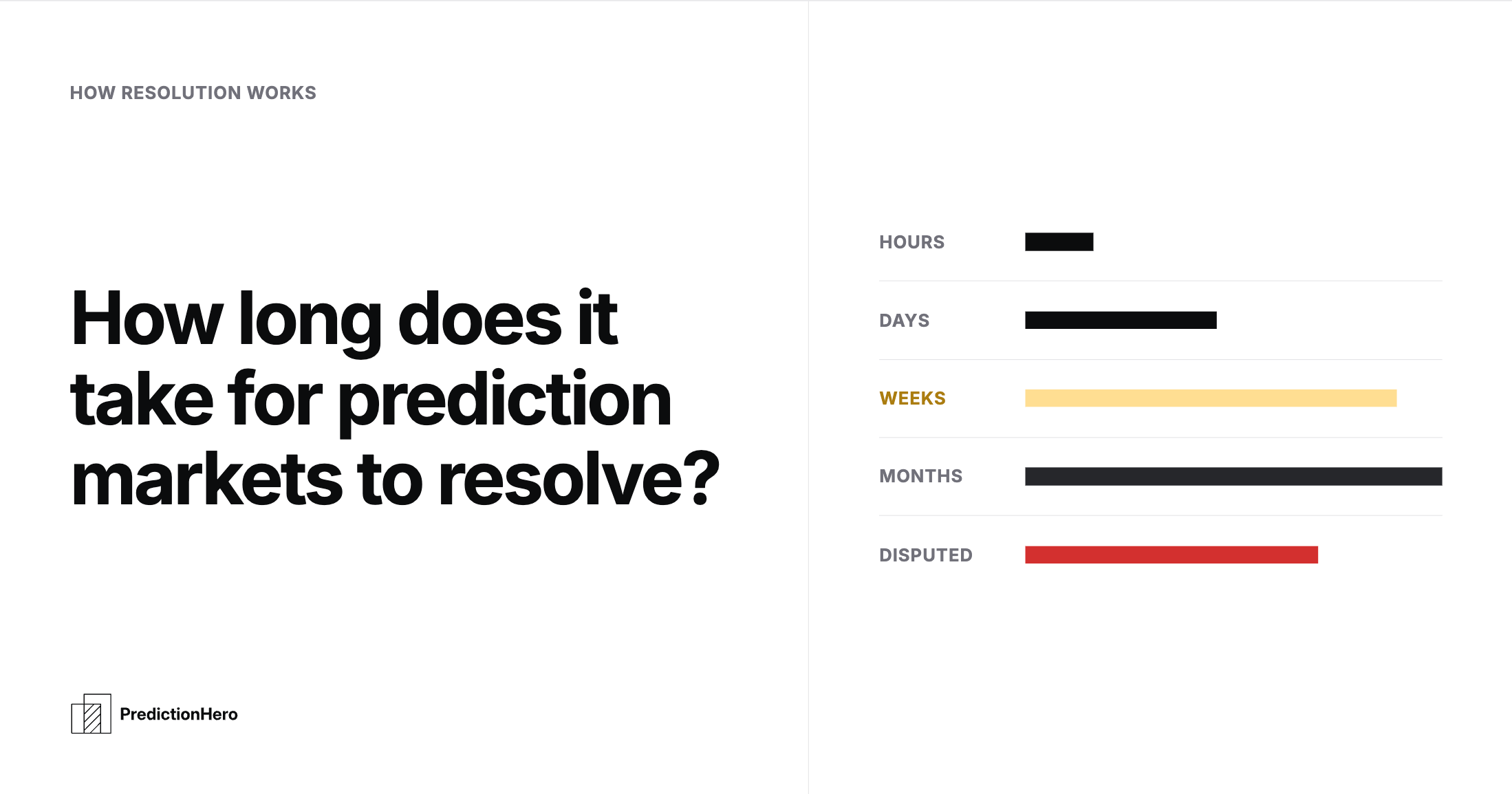
How Long Does It Take for Prediction Markets to Resolve?
Resolution speed depends on governance, not software. Kalshi confirmed a real Fed decision in eight minutes; Polymarket's identical contract took two hours because its dispute window ran uncontested.

Jared Polites
Aug 5, 2026
TL;DR
- Resolution speed depends on who confirms the outcome and what happens if someone disagrees, not on the platform's software.
- Real, live example: Kalshi confirmed the Fed's July 29, 2026 rate decision about eight minutes after the announcement. Polymarket's contract on the identical meeting confirmed the same outcome two hours and six minutes later, the full length of its built-in dispute window running uncontested.
- Kalshi, Limitless, and Predict.Fun can resolve a clean, undisputed market inside minutes to a couple of hours. Polymarket and Predict.Fun both escalate contested outcomes to UMA's token-holder vote, which takes about 48 hours once triggered.
- Every platform publishes its settlement source before a market opens. Reading it before you trade, not after, is the only way to know what "resolved" will actually depend on.
Ever put on a prediction market position and then had no idea whether it settles in ten minutes or ten days? That gap isn't random. A market resolves the moment its designated authority, an exchange's own compliance staff, a decentralized oracle, or an AI system built for the job, confirms what actually happened.
Kalshi confirmed the Federal Reserve's July 2026 rate decision within about eight minutes of the announcement. Polymarket's contract on the same meeting took just over two hours, not because anyone was slow, but because its process builds in a two-hour window for someone to object before the outcome finalizes.
That's the real question behind "how fast do prediction markets resolve": who decides, how many steps sit between the event happening and your contract paying out, and what recourse exists if you disagree with the call. Answer that and resolution speed stops being a mystery on any of the five platforms covered here.
Why Doesn't Every Prediction Market Resolve at the Same Speed?
A binary contract pays $1 to the correct side and $0 to the other once a market resolves. For "will the Fed cut rates in September," resolution can land within minutes of the announcement because the source is unambiguous and instant.
For "will this bill pass Congress by year end," resolution waits on a process that can slip, stall, or change shape entirely, and the settlement source has nothing concrete to point to until it does.
The variable isn't a platform's code. It's the event's own clarity. A market resolves as fast as its underlying question can be verified, no faster. What separates one platform from another is what happens inside that verification step: who's doing the verifying, and what happens when the first answer gets challenged.
How Fast Did a Real Fed Decision Market Actually Resolve?
Pull up the same event on two platforms right now and the gap is the whole argument. The Federal Reserve held its target rate steady at its July 29, 2026 meeting, with the announcement landing at 2:00 p.m. ET as scheduled.
Kalshi's market for that decision, ticker KXFEDDECISION-26JUL, closed trading at 1:59 p.m. ET and posted a final settlement timestamp of 2:07:36 p.m. ET, about eight and a half minutes after the announcement: staff confirmed the outcome against the FOMC's own statement and moved on.
Polymarket's contract on the identical question, part of its "Fed Decision in July?" event that carried $143,954,093.78 in trading volume, didn't settle until 4:06:41 p.m. ET, two hours and six minutes after the same announcement. Nothing about that gap points to a slower team.
Polymarket's UMA Optimistic Oracle process gives anyone a two-hour window to dispute a proposed outcome before it finalizes, and this particular contract carried a $500 proposer bond rather than the usual $750. Nobody disputed it. The market simply ran its full clock and settled right on schedule.
Kalshi's own scheduled-release markets aren't fixed to one speed either. Its June 2026 CPI market (KXCPI-26JUN) closed and settled eighteen minutes apart. The May 2026 release took over an hour to clear.
Same source (the Bureau of Labor Statistics), same staff, same rulebook, just a different real-world lag before that month's number cleared internal checks. Track this kind of side-by-side timing continuously, across the same event on multiple platforms, and you're looking at exactly the comparison an aggregator like PredictionHero is built to surface.
Who Actually Decides When a Market Resolves?
Polymarket is really two different answers to this question now. Its original, international product resolves through UMA's Optimistic Oracle: a proposer submits an outcome and posts a bond (typically $750 USDC.e), and if nobody disputes it within the two-hour challenge window, it stands, the proposer collects a small reward, and the bond returns.
Polymarket US, the CFTC-licensed entity that emerged from Polymarket's 2025 acquisition of the exchange QCEX, works differently: its own Markets Team determines outcomes directly, closer in spirit to how Kalshi resolves a contract than to the UMA process its sister product still uses.
Kalshi resolves through its own compliance and markets team, operating as a CFTC-designated exchange. Every contract lists a named source agency (the Bureau of Labor Statistics for CPI, the Fed itself for rate decisions, a sport's governing league for game outcomes) written into the market's terms before it opens.
Staff confirm the outcome against that source and settle. A trader can submit a settlement request through the platform, but it's a suggestion, not a binding trigger.
Limitless resolves the fast, mechanical way for most of its volume: a Pyth Network price feed confirms crypto and stock-price contracts automatically the moment a deadline passes, no proposer and no dispute window involved. Markets tied to a custom, non-price event get a manual review from the Limitless team instead, typically landing 24 to 72 hours after the deadline.
Predict.Fun runs a hybrid model on its BNB Chain markets. An AI system proposes an initial outcome from public information, a human team checks that proposal against primary sources, and the result posts on-chain with its own challenge window attached.
Left uncontested, that resolves in about two hours. Contested, it escalates to the same UMA Optimistic Oracle Polymarket uses, meaning two of the five platforms here lean on one identical dispute mechanism once a human disagrees.
Opinion resolves most of its markets through Opinion AI, a multi-agent oracle the platform built specifically to parse resolution criteria for questions too unstructured for a simple price feed. For contracts with a clean data source, mostly the macro releases (CPI, GDP, FOMC decisions) that make up much of its catalog, Opinion instead pulls from third-party oracles like Chainlink.
Opinion doesn't publish a formal, step-by-step dispute process the way Kalshi and Polymarket do. If you're trading a contested Opinion market, that's worth knowing before you enter, not after.
How Do the Five Platforms Compare on Resolution Governance?
| Platform | Who Resolves | Dispute Path | Regulatory Status |
|---|---|---|---|
| Polymarket | UMA Optimistic Oracle (international); Polymarket US Markets Team directly (US, post-QCEX) | Bonded challenge escalates to a 48-hour UMA token-holder vote | Polymarket US is CFTC-licensed via QCEX; the international product operates offshore |
| Kalshi | Kalshi's own compliance and markets staff, against a named source agency | Internal Outcome Review Committee and Appeal Committee, both Kalshi board panels | CFTC-designated contract market |
| Limitless | Pyth Network oracle (automated) for price markets; Limitless team for custom markets | Contact support before redemption; misresolutions refund the position size, not the $1 payout | Operates on-chain, outside US exchange registration |
| Predict.Fun | AI-assisted proposal, human-verified, posted on-chain | Uncontested in ~2 hours; contested claims escalate to UMA's Optimistic Oracle | Built on BNB Chain, outside US exchange registration |
| Opinion | Opinion AI (multi-agent oracle) for unstructured markets; third-party oracles like Chainlink for data-driven markets | No formal dispute process publicly documented | Operates outside US CFTC registration |
Read this table for structure, not for a universal speed ranking. A CFTC-designated exchange with staff resolution and a decentralized oracle with a bonded dispute window are solving the identical problem, confirming a real-world fact, through genuinely different governance.
Neither approach is inherently faster; the Fed-decision example above shows the centralized model winning on this particular event by about two hours, but a contested Kalshi market can sit with its Outcome Review Committee for longer than a disputed UMA vote takes to resolve.
What Actually Slows a Resolution Down?
Two things stall a market's timeline before any dispute even enters the picture.
Ambiguous settlement language. If a market's rules don't precisely define the source and threshold for resolution, any close call invites a challenge.
Polymarket's own market descriptions often build in a fallback (its esports contracts, for instance, specify that a match delayed more than seven days resolves 50-50), precisely because vague language is where disputes start.
Delayed or restated source data. If a market resolves against a government report or index, and that source itself is late or gets revised, resolution waits on the source, not the platform.
That's exactly what shows up in the CPI timing gap above: Kalshi's process was identical for both releases, and the outcome still landed 18 minutes apart from over an hour apart depending on how quickly that month's BLS number cleared.
The fastest resolutions happen on markets with an unambiguous source, a fixed publication time, and nobody contesting the call, think a scheduled Fed decision or CPI print landing on time. The slowest happen when the event itself stays genuinely unsettled even after it occurs, like a contested vote count or a bill that changes form multiple times before final passage.
What Happens When a Resolution Is Disputed?
Governance gets tested hardest when a call is genuinely contested, and the clearest public example is Polymarket's. In March 2025, a $7 million contract asking whether Ukraine would agree to a minerals deal with the US before April saw its "Yes" price jump from 9% to 100% within a single day, then finalize as "Yes" on March 27 even though no official deal had been signed.
That jump triggered exactly the process UMA is designed for: a proposer posted the outcome, a challenger posted a matching bond to dispute it, and UMA token holders voted.
Polymarket called the result "unexpected" but stood behind the vote rather than reversing it, and has since committed to clearer resolution language for ambiguous political-outcome markets going forward.
Reporting on the vote also surfaced a structural detail worth knowing before relying on a disputed outcome: a Wall Street Journal review of contested Polymarket votes found that large UMA token holders, some of whom also held positions in the markets they were ruling on, cast a disproportionate share of the ballots in several disputes.
Kalshi's governance carries a version of the same trade-off, just centralized instead of distributed. There's no token vote to worry about, but there's also no outside party to appeal to.
A disputed Kalshi outcome goes to the exchange's own Outcome Review Committee, a panel of the board that must include at least two public directors, and formal appeals from there go to a separate Appeal Committee, both defined in Kalshi's CFTC-filed rulebook. Nothing about that path sits outside Kalshi itself.
Put the two side by side and the trade-off is plain: decentralized governance risks a concentrated vote; centralized governance risks having no outside check on the final call at all. Every platform in this comparison has picked one of those two trade-offs. None has solved the underlying problem.
What Can You Do If You Disagree With How a Market Resolved?
Every platform here publishes settlement rules before a market opens, and every one gives traders some path to contest a call they think is wrong. The strength of that path tracks the governance model above.
On Polymarket and Predict.Fun, disputing means posting a bond that matches the proposer's, which triggers a review or an UMA token-holder vote, transparent, but it costs real capital and real time. On Kalshi, disputing means routing through the exchange's own Outcome Review or Appeal Committee, with no independent arbitrator outside the exchange.
Limitless asks disputers to contact support directly (via the platform, email, or Discord) before redemption closes. Opinion doesn't publish a comparable formal channel at all.
Read the settlement source before you take a position, not after. It's written into every market's rules on every one of these five platforms, and it tells you exactly what has to happen, and be confirmed, for the contract to pay out.
If you want the deeper context on how these same governance differences play out day to day, our full Kalshi review and our Kalshi vs Polymarket comparison both dig further into custody, fees, and dispute handling beyond resolution speed alone. And if you're new to how a contract price maps to a probability in the first place, our prediction markets explainer is the place to start.
Frequently asked questions
Anywhere from minutes to weeks, and it depends on the event, not the platform. Kalshi settled its July 2026 Fed decision market about eight minutes after the announcement. A market tied to a contested or slow-moving event, a legislative vote or a recount, can stay open well past the event date while its resolution source gets confirmed.
No. Kalshi's compliance staff confirm outcomes directly against a named source agency and settle. Polymarket's international product uses UMA's Optimistic Oracle: a proposer posts a bond, anyone can challenge it within two hours, and an unresolved challenge escalates to a 48-hour token-holder vote. Polymarket US resolves more like Kalshi, with its own Markets Team deciding directly.
It depends on the platform. On Polymarket and Predict.Fun, disputing means posting a bond before a challenge window closes. On Kalshi, a disputed outcome goes to the exchange's own Outcome Review or Appeal Committee. Limitless asks you to contact support directly. None of the five offer an outside, independent arbitrator.
Not necessarily. Kalshi's staff-confirmed process settled a Fed decision in about eight minutes; Polymarket's identical contract took two hours because its dispute window ran its full course, uncontested, before finalizing. The speed gap here reflects two different verification processes, not two different levels of accuracy.
Kalshi confirms outcomes directly against a named source once staff can verify it, with no built-in waiting period. Polymarket's UMA process gives anyone a two-hour window to dispute a proposed outcome before it finalizes, so even an uncontested Polymarket market waits out that full window before settling.
Sources
- Kalshi Trade API and Polymarket Gamma API, live and historical market data (settlement timestamps, volume, bond sizes) pulled directly, August 5, 2026.
- Polymarket Help Center. "How Are Markets Disputed?" help.polymarket.com
- Polymarket Documentation. "Resolution." docs.polymarket.com
- CoinDesk. "Polymarket, UMA Communities Lock Horns After $7M Ukraine Bet Resolves." March 27, 2025. coindesk.com
- DeFi Rate. "How Kalshi and Polymarket Settle Event Contracts (and Disputes)." defirate.com
- KalshiEX LLC DCM Rulebook, filed with the CFTC. cftc.gov
- Limitless Exchange Documentation. "Market Resolution." docs.limitless.exchange
- Opinion.Trade Documentation. "Resolution." docs.opinion.trade
---
PredictionHero aggregates publicly available prediction market data for informational purposes only. This is not financial advice. Prediction markets may not be available in all jurisdictions.
Related
Is Kalshi Legit? A Data-Backed Review (2026)
Yes, Kalshi is CFTC-regulated and has been since 2020. Here's what that actually protects, what the fees really cost, what deposits and withdrawals are like, and the state-by-state legal fight.
Jared Polites · Jul 28
Kalshi vs Polymarket: Which Prediction Market Is Right for You?
Kalshi is CFTC-regulated and dollar-funded. Polymarket runs on USDC with deeper global liquidity and now has its own regulated US arm too. Compare live.
Jared Polites · Jul 30

How Accurate Are Prediction Markets? What the Resolved-Market Data Shows
Calibration, not who-won, is the real test of prediction market accuracy. Here's what large samples of resolved contracts actually show, and where the record breaks down.
Jared Polites · Jul 26