TOTAL VOLUME:
$126.8b
24H VOL:
$112,645,293
24H TRANSACTIONS:
2,159,476,470
OPEN INTEREST:
$1,326,543,503
338,184
Markets across
31,563
events
MATCHED EVENTS:
2,852
PLATFORM COVERAGE:
5
Polymarket:
40%
VS.
Kalshi:
60%
How to Read Prediction Market Rules Before You Trust the Price
Two platforms can price the same event five points apart, not because traders disagree, but because the contracts ask slightly different questions. Read the wording before you read the price.

Jared Polites
Sep 10, 2026
A prediction market's price is only as good as its wording. Before you cite a number or compare odds across platforms, read the exact resolution criteria: what counts as "yes," when the market closes, and who decides. Skip that step and you're trusting a probability you haven't actually verified.
This matters more than most readers assume. Two platforms can list what looks like the "same" market on the same event and price it five points apart, not because traders disagree, but because the contracts are asking slightly different questions. A journalist citing "the market says 70%" without reading the fine print is citing a number that might resolve on a technicality no one priced in.
The Wording Is the Contract
A prediction market contract is a specific, verifiable proposition. Not "will the economy improve," but "will the Bureau of Labor Statistics report a headline CPI figure above 3.0% for the June 2026 release." The second version has a defined source, a defined threshold, and a defined date. The first version has none of that, and any market built on it is a market you should not trust as a data point.
Vague prediction market questions fail in three specific ways, and each one changes what the contract actually pays out on:
- Undefined source. "Will X win the election" needs a named authority (the Associated Press call, the certified state result, a specific news desk) or the market operator ends up making a judgment call after the fact.
- Undefined threshold. "Will inflation be high" is not a contract. "Will CPI exceed 3.0%" is. The number is the market; without it, resolution is a debate.
- Undefined scope. "Will the deal happen" doesn't say which deal, which parties, or what counts as "happening" (signed, announced, closed, funded).
Read the full resolution criteria before you read the price. Most platforms publish this as a separate section on the market page, often collapsed under "Rules" or "Resolution Details." It is usually longer and more boring than the headline question. Read it anyway.
Deadlines: Tight vs. Loose
The close date and the resolution date are not always the same thing, and conflating them is one of the most common mistakes when comparing markets across platforms.
A tight deadline resolves on a fixed, unambiguous date: "Resolves YES if the event occurs before 11:59pm ET on December 31, 2026." There's no room for interpretation about timing.
A loose deadline uses language like "by the end of the year" or "in the near term" without specifying a time zone, an exact date, or what happens if the event occurs one day after the window closes. Say a contract asks whether a company will "launch its product this year." Does that mean announced, shipped to a limited beta, or generally available? A tight contract would specify one of those and name the exact cutoff date and time zone. A loose one leaves it to the market operator's discretion when the deadline arrives, which means the resolution can hinge on a judgment call made after most of the trading has already happened.
When you're comparing the "same" event across Polymarket, Kalshi, Limitless, Predict.Fun, and Opinion, check whether all five are using the same deadline and the same time zone. A market that closes at midnight UTC and one that closes at midnight ET are not the same market, and a one-point price difference between them might just be a four-hour window, not a disagreement about the outcome.
Edge Cases That Change the Payout
Every well-written market has a section addressing what happens if the world doesn't cooperate with the question. Look for how the contract handles:
- Postponement or cancellation. If the underlying event doesn't happen at all (a game is postponed, a hearing is delayed), does the contract resolve NO, refund, or extend? These three outcomes pay very different amounts to very different people.
- Ambiguous outcomes. If the event technically occurs but not in the form the question anticipated (a candidate withdraws after the question was written, a company merges instead of "launching"), what's the fallback rule?
- Data source failure. If the market resolves off a specific data release and that release is delayed or revised, does the contract wait for the revision or lock in the original number?
Kalshi, as a CFTC-regulated exchange, tends to write the tightest resolution language because it has to hold up to regulatory scrutiny. That's a durable structural fact, not a live statistic: the regulatory requirement to specify a resolution source and a fallback in advance is a permanent feature of how a CFTC-regulated exchange operates, not something that varies week to week. Platforms with looser oversight can leave more resolution discretion to internal moderators, which isn't automatically wrong, but it's a different kind of contract and it should be priced with that in mind.
A Worked Example
Say a contract is titled "Will the merger close in 2026?" and trades at $0.35. That's a 35% implied probability on its face. But read the resolution section and suppose it specifies: resolves YES only if regulatory approval AND shareholder approval AND the transaction formally closes, all before December 31, 2026, 11:59pm ET, sourced from the company's own SEC filing. Now you know the 35% isn't pricing "will this merger happen eventually." It's pricing a much narrower and harder outcome: three specific approvals, on a specific timeline, confirmed through a specific filing. A contract with looser wording, no named approvals, no filing requirement, might price the same underlying deal at 48%, because it's actually a different, easier question. The gap between 35% and 48% isn't a market disagreement. It's two different contracts wearing the same headline.
Structural Differences Worth Checking Before You Compare
| Platform | Regulatory status | How resolution disputes are handled |
|---|---|---|
| Kalshi | CFTC-regulated exchange | Formal resolution sourcing required per contract, subject to regulatory oversight |
| Polymarket | Operates through separate products by jurisdiction | Uses a decentralized dispute process (UMA) for contested resolutions |
| Limitless | On-chain, token-based | Resolution disputes handled through platform moderation and on-chain rules |
| Predict.Fun | On-chain (BNB Chain), backed by YZi Labs | Platform-defined resolution sources, moderated internally |
| Opinion | Crypto-native, macro-focused | Platform-defined resolution sources, moderated internally |
This table compares how each platform is built to handle a dispute, not what any of them are currently pricing. That's the part that stays true next month.
Why This Matters More for Cross-Platform Comparison
PredictionHero aggregates the same events across all five platforms specifically because the wording gap is where most cross-platform confusion comes from. When two platforms show different consensus numbers for what looks like one event, the first question isn't "which market is smarter." It's "are these two contracts actually asking the same question, with the same deadline, sourced the same way." Often they're not, and the price gap is explained the moment you read both rule sets side by side.
Frequently asked questions
Resolution criteria are the specific rules a contract uses to determine its outcome: the data source, the exact deadline, and the fallback rules for ambiguous or unexpected results. They're usually published in a separate section from the headline question.
Usually because the contracts aren't identical. Different deadlines, different data sources, or different scope (what exactly counts as the event happening) can produce different prices even when traders agree on the underlying probability.
Read the full resolution wording, not just the headline question. Confirm the deadline, the named data source, and how the contract handles postponement or ambiguous outcomes.
They're rarer on regulated exchanges like Kalshi, where resolution sourcing is required, and more variable on platforms that rely on internal moderation. Always check the specific contract rather than assuming based on the platform.
PredictionHero aggregates publicly available prediction market data for informational purposes only. This is not financial advice. Prediction markets may not be available in all jurisdictions.
Related
Why Prediction Market Odds Disagree Across Platforms (And How to Read the Gap)
A price gap between Polymarket and Kalshi isn't a pricing error. Find out what it really represents.
Jared Polites · Aug 19
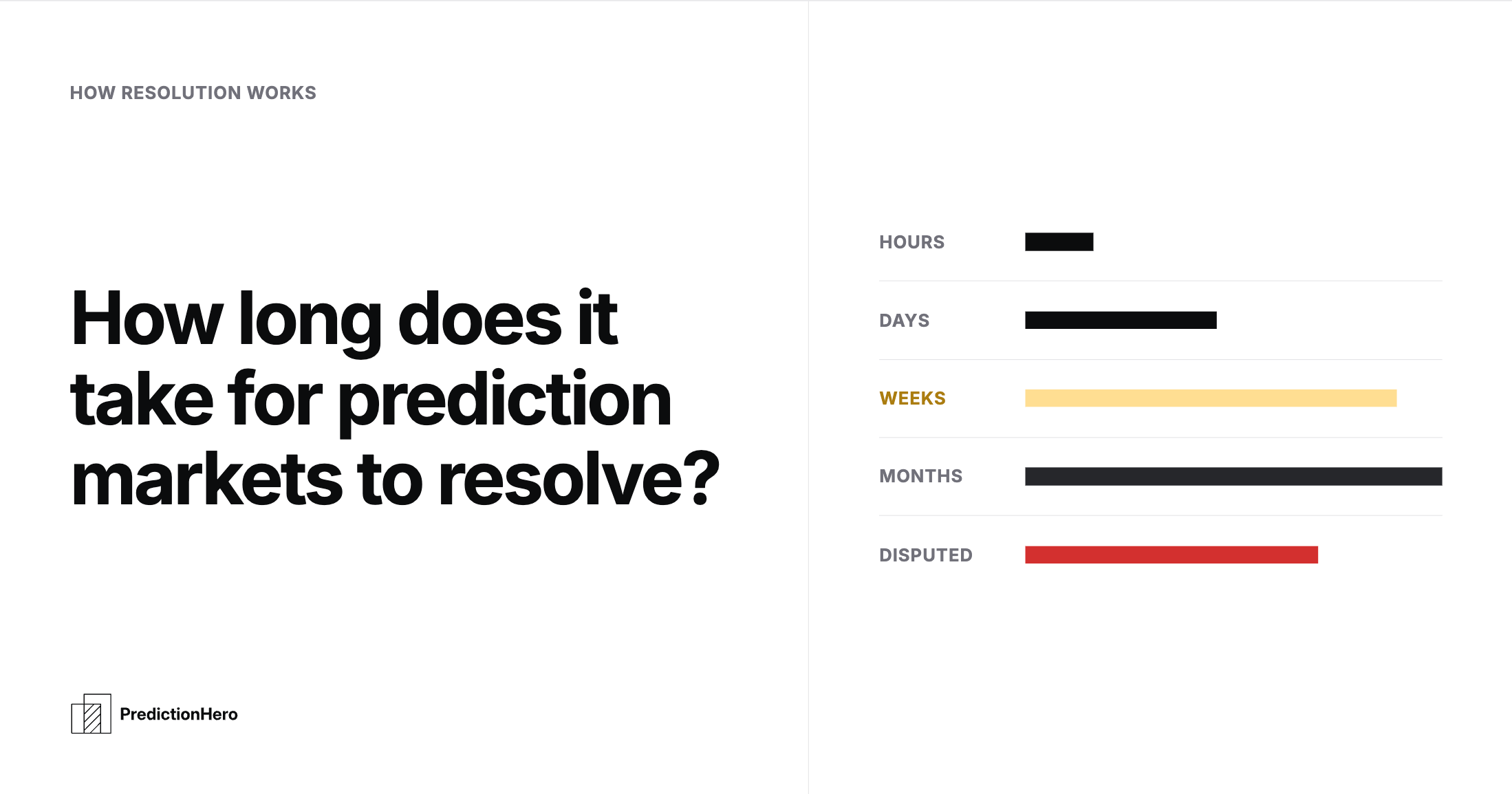
How Long Does It Take for Prediction Markets to Resolve?
Resolution speed depends on governance, not software. Kalshi confirmed a real Fed decision in eight minutes; Polymarket's identical contract took two hours because its dispute window ran uncontested.
Jared Polites · Aug 5
Prediction Market Overround: Why the Odds Don't Add Up to 100%
A three-candidate market pricing at 105 cents isn't broken. Here's what that extra 5 cents actually means and why sportsbook vig is a different animal.
Jared Polites · Sep 6