TOTAL VOLUME:
$140.8b
24H VOL:
$144,135,865
24H TRANSACTIONS:
2,543,053,589
OPEN INTEREST:
$1,584,572,666
414,590
Markets across
32,761
events
MATCHED EVENTS:
2,820
PLATFORM COVERAGE:
5
Polymarket:
39%
VS.
Kalshi:
61%
Why Prediction Market Odds Disagree Across Platforms (And How to Read the Gap)
A price gap between Polymarket and Kalshi isn't a pricing error. Find out what it really represents.

Jared Polites
Aug 19, 2026
TL;DR
- A price gap between platforms isn't an error to fix. It comes from who's trading, how the contract is worded, how much liquidity backs the price, and how fast each order book reacts to news.
- Kalshi's traders access it through CFTC-regulated US bank rails. Polymarket's original product resolves through UMA's decentralized dispute process, while its separate, CFTC-licensed Polymarket US arm (built on the 2025 QCEX acquisition) has its own team decide outcomes directly instead.
- A thinly traded market can swing on a single large position; a deep one absorbs it. Check liquidity on both sides before treating a spread as a genuine disagreement rather than noise.
- The gap itself is the finding. When two platforms converge, the market has resolved its own disagreement. When they diverge, something is still being priced into one side and not the other.
Pulled up the same event on two platforms and gotten two different numbers? You didn't do anything wrong, and neither price is broken. Polymarket might price an outcome at 40% while Kalshi prices the same-looking event at 55%, and that gap is telling you something specific: who's trading each contract, how it's worded, and how much liquidity sits behind each number.
A prediction market odds disagreement isn't an error to resolve. It's information about the market underneath the price, and reading it correctly is more useful than deciding which platform got it "right."
Why Do Prediction Markets Disagree on the Same Event?
Five platforms now carry meaningful volume: Polymarket, Kalshi, Limitless, Predict.Fun, and Opinion. Each one is a separate market with its own traders, its own exact contract wording, and its own liquidity. When their prices diverge on what looks like the same event, four mechanics are almost always the reason.
How Much Does Each Platform's Trader Base Shape Its Price?
Kalshi is a CFTC-regulated exchange, and its retail base accesses it through a bank transfer, not a crypto wallet. Polymarket runs largely on crypto-native, global traders positioning in USDC.
That split got more literal in 2025. Polymarket's original product still resolves through UMA's oracle process and operates offshore. Its newer Polymarket US arm, built on its acquisition of the CFTC-licensed exchange QCEX, gives US traders a separate, regulated entry point instead, with outcomes decided by its own team rather than UMA's dispute system.
Limitless runs a dedicated Korean market category alongside its main board, a real structural signal that its order books draw a meaningfully different regional audience than a US-only exchange does. Predict.Fun draws traders who think about capital efficiency: deposited collateral routes through Venus Protocol on BNB Chain and earns yield for as long as a position stays open, so holding through a slow-moving event costs less than it would on a platform where capital just sits idle.
Opinion built its base around macro trading, FOMC decisions, CPI prints, GDP prints, so its traders bring a different set of assumptions into any market it lists, sports included.
Different crowds price the same outcome differently because they hold different information, different home-country bias, and different risk appetite. A US-heavy audience often leans harder into a domestic outcome than a global crypto audience does. That's not noise. That's the composition of the market talking.
Could Two "Identical" Contracts Actually Be Asking Different Questions?
Two contracts can look the same and still resolve on different criteria. "Will the Fed cut rates in September" and "Will the Fed cut rates by 25 basis points or more in September" are not the same question. A platform's exact resolution language, its sourcing rules, and its cutoff time all shift where a rational trader prices the contract.
Read both resolution criteria before comparing two platforms' odds on "the same" event. A five-point spread often turns out to be two different questions wearing one headline. Our breakdown of how markets resolve covers who writes that settlement language on each platform and what happens when it's ambiguous.
Why Does Liquidity Depth Change How Much You Should Trust a Price?
A thinly traded market moves on a single large position. A deeply traded one absorbs it and barely shifts. If one platform carries most of the volume on an event and another has a fraction of it, the thinner market's price is more likely stale, skewed by one trader, or still catching up.
Depth isn't only about a tighter spread. It's about how much you should trust the number in the first place. A wide bid-ask spread on low volume is a warning that the quoted price hasn't been tested by real size, and our explainer on what prediction market volume actually measures walks through why a big volume figure and a deep, tradeable market aren't automatically the same thing.
Why Do Some Platforms React to News Slower Than Others?
News doesn't reach every order book in the same second. A platform with thinner liquidity or a smaller active trader base can sit on yesterday's price while a deeper, faster-moving market has already repriced on new information.
When you see a wide gap right after a headline, check timestamps before you check anything else. The "disagreement" often closes within hours once the slower market catches up to the one that moved first.
How Do You Read a Cross-Platform Spread Instead of Picking a Winner?
The instinct is to ask which platform is right. The better question is what the gap itself is telling you. Work through it in order.
- Confirm it's the same question. Pull the resolution criteria on both platforms. If the wording differs even slightly, the gap may not be a disagreement at all.
- Check the depth on each side. A wide spread backed by real liquidity on both platforms is worth investigating. A wide spread where one side is thin is more likely noise than signal.
- Consider who's actually trading. A regulated US exchange full of domestic traders and a global crypto-native exchange weigh the same news differently. Ask what each crowd knows, or believes, that the other doesn't yet.
- Look at the direction of movement, not just the level. If both platforms are converging over the past day, the market is resolving its own disagreement. If they're diverging, something new is being priced into one side only.
- Treat the spread as the finding. The gap itself, not either individual price, is often the most informative number in the market. A 40/55 split says the outcome is genuinely contested in a way a single 47% consensus never would.
Here's a hypothetical to make the mechanic concrete, not a live example. Say Kalshi prices a Fed rate decision at 60% for one outcome and Polymarket prices it at 45%. If Kalshi's US-based traders are weighting a recent domestic jobs report more heavily, and Polymarket's global base is weighting a hawkish comment from a regional Fed president that hasn't fully reached Kalshi's book yet, that 15-point gap isn't a mispricing. It's two different information sets that haven't reconciled yet. The reconciliation, when it happens, is itself worth watching.
Which Platform Differences Are Structural, Not Just Event-by-Event?
Some divergence is a one-off, tied to a single event. Some is structural, built into how a platform operates, and holds across events rather than resetting each time.
| Platform | Regulatory Status | Collateral / Access | Distinct Trait |
|---|---|---|---|
| Polymarket | International product operates offshore; Polymarket US is CFTC-licensed via the 2025 QCEX acquisition | Crypto (USDC) | Deepest global liquidity on most major events |
| Kalshi | CFTC-regulated exchange | USD, bank transfer | US retail access with no crypto setup required |
| Limitless | On-chain (Base), outside US exchange registration | Crypto | Dedicated Korean market category |
| Predict.Fun | On-chain (BNB Chain), outside US exchange registration | Crypto | Idle collateral earns yield via Venus Protocol |
| Opinion | Operates outside US CFTC registration | Crypto | Built around macro releases, not sports |
A table like this stays useful over time because it describes what each platform is, not what any one contract is priced at today. Live spreads change by the hour. Regulatory status and settlement mechanics don't.
So Which Prediction Market Has the "Right" Odds?
None of them, individually. Each platform's price is the collective estimate of that platform's own traders, given that platform's information and liquidity. Averaging across Polymarket, Kalshi, Limitless, Predict.Fun, and Opinion produces a consensus that smooths out any single platform's audience bias.
That consensus is a better estimate than any one price in isolation, but it's still an estimate, not a verdict. Checking multiple platforms isn't about finding the correct one. It's about seeing where they agree, which tells you the market has converged on shared information, and where they don't, which tells you something is still being priced in. Our look at prediction market accuracy against resolved-market data goes further into how well that consensus tracks real outcomes over time.
A trader who only watches Kalshi sees a US-skewed read. A trader who only watches Polymarket sees a global, crypto-native read. Comparing Kalshi, Polymarket, Limitless, Predict.Fun, and Opinion side by side is what turns five separate opinions into one usable picture. If you're still new to how a contract's price maps to a probability in the first place, our prediction markets explainer is the place to start, and PredictionHero's own trending markets view shows that comparison live across all five platforms in one screen instead of five open tabs.
Frequently asked questions
Because they aren't the same market. Each platform has its own traders, its own liquidity depth, and often slightly different resolution wording for what looks like an identical question. The price reflects that platform's specific pool of information and participants, not a universal truth.
Not necessarily. A wide spread backed by real liquidity on both sides usually means the outcome is genuinely contested and traders are weighting information differently. A thin, low-liquidity market moving on one large position deserves more skepticism than a wide spread by itself.
None consistently outperforms the others across every event. Polymarket typically carries the deepest liquidity on major global events, Kalshi's regulated US base often prices domestic outcomes with more precision, and smaller platforms can lead on niches where their trader base pays closer attention. Comparing all five gives a fuller picture than trusting any single price.
That's a decision for you to make, not something this framework decides for you. What matters first is understanding why the numbers differ, resolution wording, liquidity, audience, and timing, before deciding what the gap means for your own view.
Sources
- Polymarket Documentation. "Resolution." docs.polymarket.com
- PR Newswire. "Polymarket Acquires CFTC-Licensed Exchange and Clearinghouse QCEX for $112 Million." prnewswire.com
- CryptoBriefing. "Polymarket Gains CFTC Approval to Launch Regulated US Prediction Markets." cryptobriefing.com
- Bitrue. "What Is Predict.fun? Prediction Market on BNB Chain." bitrue.com
- KalshiEX LLC DCM Rulebook, filed with the CFTC. cftc.gov
---
PredictionHero aggregates publicly available prediction market data for informational purposes only. This is not financial advice. Prediction markets may not be available in all jurisdictions.
Related
How Accurate Are Prediction Markets? What the Resolved-Market Data Shows
Calibration, not who-won, is the real test of prediction market accuracy. Here's what large samples of resolved contracts actually show, and where the record breaks down.
Jared Polites · Jul 26
What Does Prediction Market Volume Actually Mean?
Volume is the total traded over time. Open interest is what's still at stake right now. Liquidity is what you can trade this instant, and most headlines quietly blur all three into one number.
Jared Polites · Aug 5
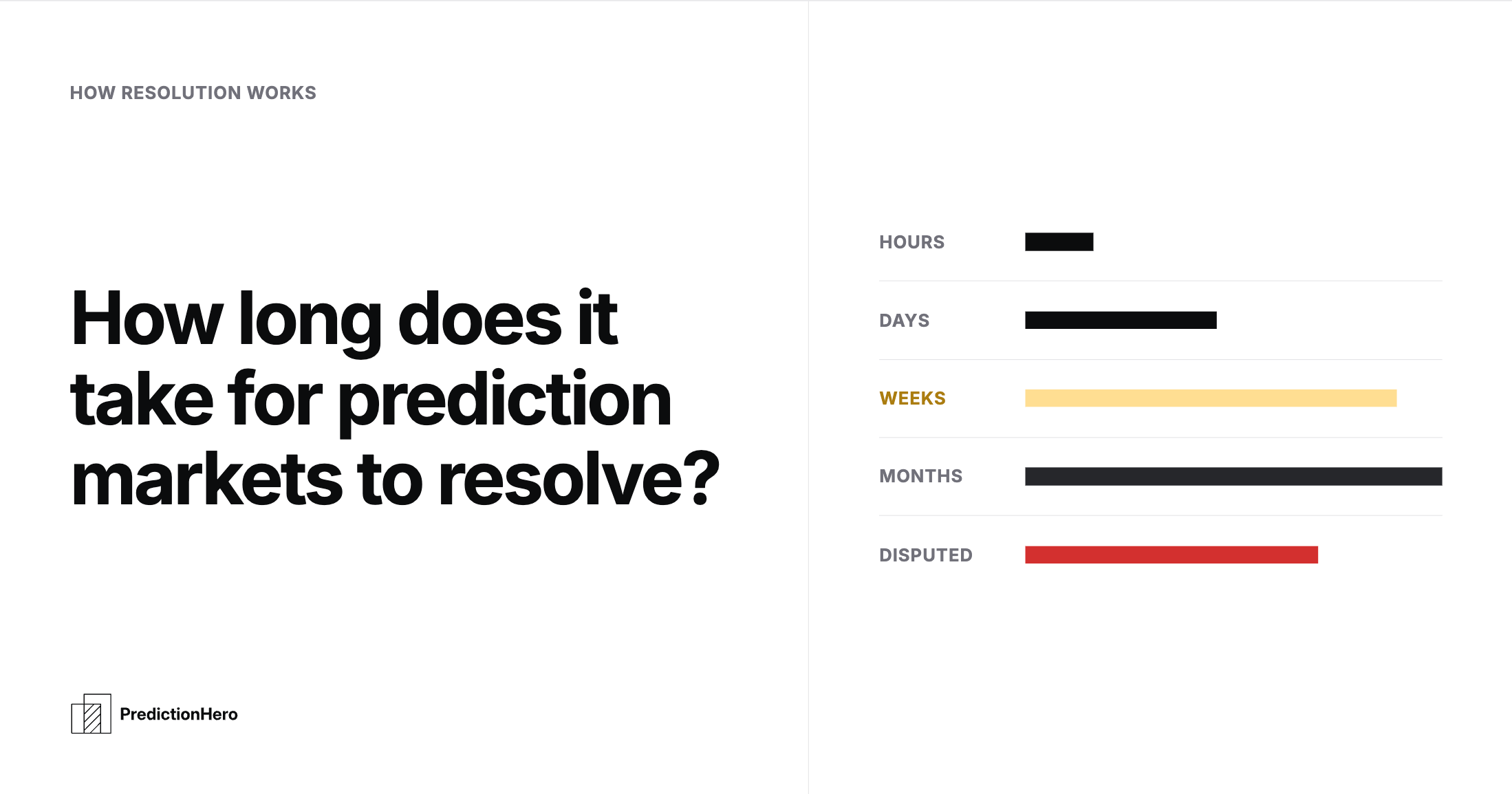
How Long Does It Take for Prediction Markets to Resolve?
Resolution speed depends on governance, not software. Kalshi confirmed a real Fed decision in eight minutes; Polymarket's identical contract took two hours because its dispute window ran uncontested.
Jared Polites · Aug 5