TOTAL VOLUME:
$149.2b
24H VOL:
$225,634,708
24H TRANSACTIONS:
2,818,747,506
OPEN INTEREST:
$1,877,297,258
449,684
Markets across
33,836
events
MATCHED EVENTS:
2,677
PLATFORM COVERAGE:
5
Polymarket:
38%
VS.
Kalshi:
62%
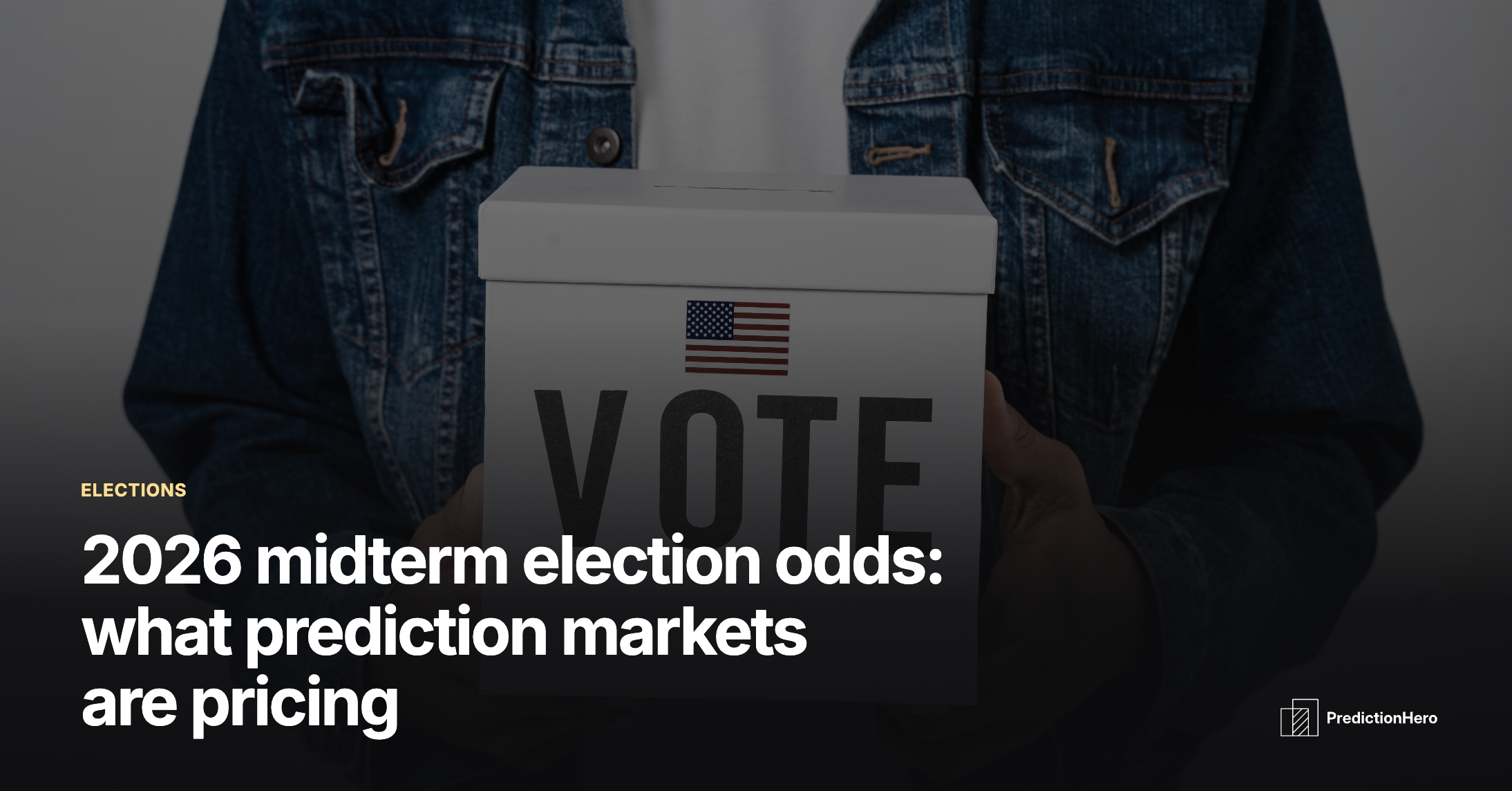
2026 Midterm Election Odds: What Prediction Markets Are Pricing
How to read 2026 midterm election odds: what House and Senate control contracts measure, why they differ, and how to check a price before you trust it.

Jared Polites
Oct 18, 2026
TL;DR
- 2026 midterm election odds come from separate contracts for House control and Senate control, and each price is the market's implied probability that a party wins that chamber.
- Election Day is Tuesday, November 3, 2026. All 435 House seats are on the ballot, so the House contract prices a national swing, while the Senate contract prices a short list of state races.
- Polymarket and Kalshi can price the same chamber a few points apart, and Limitless, Predict.Fun and Opinion each decide which midterm contracts they list. Check every board before comparing.
- A price near 90% is not a call. It still loses roughly one time in ten, and a close race can leave a contract open long after election night.
Heard a news anchor say "the markets give one party a 60% chance" and wondered where that number comes from? It comes from traders putting money behind a chamber, and Polymarket midterms contracts are one place to see it.
The catch is that "the midterms" is really several contracts: one for the House, one for the Senate, and combined markets for both. Each price is the market's probability for one outcome. This guide shows what each one measures, how to compare them across platforms, and what to check before you quote one. Every price comes from prediction market data across the five platforms PredictionHero tracks.
What Do 2026 Midterm Election Odds Actually Measure?
They measure the chance that a party controls a chamber after the election, as set by traders. Each outcome trades between $0 and $1. A Democratic House contract at $0.80 means the market gives Democrats an 80% chance of winning the House.
Here is the current read. PredictionHero Cross-Platform Consensus currently has Democrats leading the house 88% and also leading the Senate race at a slightly smaller 66.3%.
Why Do House and Senate Odds Differ?
The two chambers are built differently, so they price differently. The House has 435 seats, all up for election, so control tends to track the national mood across hundreds of districts. A small shift can move many seats at once.
The Senate has only a share of its seats on the ballot. Control can turn on a handful of state races, which means one surprising result can flip the whole chamber. That is why the two chambers can tell different stories in the same year.
Neither chamber's price is a forecast of the other. When both move together, it usually means a national shift. When only one moves, look for a local story.
What Do Polymarket Midterms Markets Show Compared With the Other Platforms?
Polymarket midterms markets show the same elections through a different crowd. Polymarket runs its own order book and trader base, so its price for a chamber can sit a few points away from the same outcome elsewhere.
That gap is normal. It does not mean one platform is wrong. Each venue has its own traders and liquidity, and its own settlement rules. That is the subject of our piece on why odds disagree across platforms.
Kalshi is a CFTC-regulated exchange with its own midterm contracts, and its prices can differ from Polymarket's for the same reasons.
Opinion is built around macro contracts, so its board is worth a look for the same elections. Limitless and Predict.Fun round out the five platforms PredictionHero tracks.
Which midterm contracts each one lists changes as the election gets closer, so check each board directly. PredictionHero lines up prediction market data from all five platforms on one screen, so the spread between platforms is visible without opening five tabs.
How Do Combined House and Senate Markets Work?
A combined market prices the two chambers together. A common version asks for the balance of power: a Democratic sweep, a split Congress, or a Republican sweep. Right now the market puts a Democratic sweep at [PILL: Democratic sweep probability].
The combined price has to stay consistent with the two single-chamber prices. That link is the subject of our guide to correlated markets.
It also works as a cross-check. If a sweep is priced higher than either chamber alone could support, one of the prices is stale or thin.
What Happens to These Contracts After Election Night?
A contract resolves when the outcome is settled under its own rules, which can take longer than election night. A close race can head into a recount or certification, and a chamber contract waits on the last seat that decides control.
That is why an election market can stay open after the news calls a race. Our walkthrough of election resolution covers how that plays out on each type of contract.
Before you trade or quote a price, read what counts as control in that contract. Ties, vacancies and independents who caucus with a party are the details that decide a close one.
How Should You Read Midterm Odds Before Election Day?
Run through five checks, in this order.
- Timestamp. Midterm prices move with every poll and news cycle. A number from this morning may be stale by tonight.
- Which contract. House, Senate, a single race and a balance-of-power market answer different questions.
- Depth. Check volume and spread, not just the last trade. A thin market is closer to a few opinions than a consensus.
- A second platform. One venue can lag. Two venues that agree are harder to dismiss.
- The track record. Prices are probabilities, not guarantees. See how well prediction market accuracy holds up across resolved markets.
A price near 90% still loses about one time in ten. Treat a favorite as the likeliest outcome, not the only one.
They change throughout the day, so use the live prediction market data in this article rather than a number copied from another page. House control, Senate control and the combined balance of power each have their own contract and their own price, and the live values show how the market weighs each one right now.
The midterm general election is Tuesday, November 3, 2026. All 435 House seats are on the ballot, along with a share of the Senate. Contracts may take longer than election night to resolve if a race is close or goes to a recount.
No single platform wins on every count. Polymarket, Kalshi, Limitless, Predict.Fun and Opinion each run their own order book and trader base. Compare volume and spread on each board, read each platform's resolution rules, and treat agreement across platforms as a stronger signal than any one price.
A balance of power market prices the two chambers together, with outcomes such as a Democratic sweep, a split Congress or a Republican sweep. Its price has to stay consistent with the separate House and Senate contracts, which makes it a useful cross-check on both.
Not always. A contract resolves when the outcome is settled under its own rules. A close race, a recount or a delay in certification can keep a chamber contract open for days or longer, so read what counts as control before you rely on a quick payout.
Sources
- Legal Information Institute. "2 U.S. Code § 7: Time of election." law.cornell.edu
- U.S. House of Representatives. "Representatives." house.gov
PredictionHero aggregates publicly available prediction market data for informational purposes only. This is not financial advice. Prediction markets may not be available in all jurisdictions.
Related
Why an Election Prediction Market Can Stay Open After the News Calls the Race
A contract doesn't pay out when CNN calls it. It pays out when the specific event named in its resolution criteria actually happens, and that gap can run days or weeks past election night.
Jared Polites · Aug 29
Correlated Prediction Markets: How Related Contracts Constrain Each Other's Prices
A primary contract at 40 cents and a general contract at 45 cents for the same candidate can't both be right. The arithmetic behind correlated contracts on five prediction market platforms.
Jared Polites · Sep 15
How Accurate Are Prediction Markets? What the Resolved-Market Data Shows
Calibration, not who-won, is the real test of prediction market accuracy. Here's what large samples of resolved contracts actually show, and where the record breaks down.
Jared Polites · Jul 26