TOTAL VOLUME:
$140.7b
24H VOL:
$176,618,688
24H TRANSACTIONS:
2,543,053,589
OPEN INTEREST:
$1,606,811,120
418,163
Markets across
32,862
events
MATCHED EVENTS:
2,828
PLATFORM COVERAGE:
5
Polymarket:
39%
VS.
Kalshi:
61%
How to Spot a Manipulated Prediction Market Before You Trust the Price
Wash trading, thin-book spikes, resolution clustering, and self-dealing are the four patterns that give away a manipulated price. Here's how to check for each one.

Jared Polites
Aug 26, 2026
TL;DR
- On a binary contract, Yes and No should sum to roughly $1.00 before fees. When the math breaks, or a price moves on volume that doesn't exist, that's a reason to check further, not proof on its own.
- Four patterns show up in manipulated prediction markets: wash trading (round-trip trades with no real view behind them), a price spike on a thin order book, positions clustering right before resolution, and self-dealing on an obscure, low-volume contract.
- A genuine price move survives being retested by independent capital. A manipulated one snaps back within hours once the pressure lifts.
- Checking the same event across platforms is the fastest gut check: PredictionHero currently matches odds on 2,941 events across all five platforms it tracks, out of more than 319,000 markets total, so an outlier price on one venue stands out immediately.
Just watched a price jump 30 points in an hour with no headline to explain it? That's not proof of manipulation by itself, but it's exactly the moment to stop and check before you treat the new number as real information.
Manipulation leaves fingerprints. Four show up over and over: wash trading, a price spike on a thin order book, positions clustered right before resolution, and self-dealing on an obscure contract nobody else is watching. This piece walks through what each one looks like and how to check for it.
On a binary contract, Yes and No sum to roughly $1.00 before fees. A $0.63 Yes contract implies a $0.37 No contract. When a price breaks that math, or moves on volume that doesn't exist, the number is telling you something is off before you dig any further.
Can a Prediction Market Price Be Trusted at Face Value?
No. A price is a claim made by whoever is trading, not a verified fact.
That claim means something only if independent people, each risking real money, disagree with each other and settle on a number through competition. Take away the independence and you can still get a clean-looking price with nothing real behind it.
The chart doesn't distinguish genuine disagreement from one account trading against itself. Only the trader reading it does.
What Does Wash Trading Look Like in Prediction Markets?
Wash trading is one party, or a coordinated group acting like one, trading with itself to manufacture volume that never reflects a real change in view.
The motive is simple. Fake trading volume moves a contract up in platform rankings and can qualify for liquidity rewards on platforms that pay for depth. It also lures in real traders who read heavy activity as proof that informed money is positioned there.
Platforms have started building against this directly. Polymarket's own liquidity rewards documentation states its scoring is designed to "discourage blatantly exploitative behaviors," and the CFTC's 2026 rulemaking process for event contracts is soliciting comment specifically on wash sales and disruptive trading practices. The incentive to fake volume is real. So is the pressure closing in on it.
Three patterns tend to appear together. Repeated round-trip trades landing at nearly identical prices. Volume ticking up with no corresponding price movement, which is backwards from how real markets behave. Activity clustered in tight bursts, traceable to a small handful of wallets doing both the buying and the selling. One of these alone might be noise. All three together is a pattern.
Why Can a Low-Liquidity Market Spike on Almost Nothing?
A thin order book has almost nothing to absorb a trade, so a single, modestly sized position can throw the price sharply in one direction with no new information behind it.
That's a mechanism, not an accusation. Illiquid markets spike for innocent reasons all the time. The tell is a spike with no accompanying news, no volume follow-through after the initial move, and a snap-back to the prior level within hours.
That combination separates ordinary thin-market noise from someone using illiquidity as a tool. It doesn't take much capital to move a price nobody else is watching.
How Does a Handful of Contracts Move a Price? A Worked Example
A niche market sits at $0.50, a 50% implied probability, with almost no depth on either side of the book.
A trader buys a small block of Yes contracts, just enough to walk the price from $0.50 to $0.80. No headline moved. No new fact entered the world. The order ran through thin liquidity because there was nothing there to stop it.
Read at face value, $0.80 says the market now thinks there's an 80% chance of Yes. Read correctly, it says one order absorbed a shallow book. Those are two different claims wearing the same number.
The reveal comes a few hours later. If the price drifts back to $0.50-$0.55 with no news in between, that round trip is the signature of a manipulated spike, not price discovery. A real move survives being retested by independent capital. A manipulated one gives itself back.
Why Do Coordinated Positions Cluster Right Before Resolution?
Near resolution, the outcome is close to locked and the payout is close to certain. That creates an incentive to push the price one more time before it settles.
A coordinated push in the closing window can lock in a more favorable settlement reference, or shape how a market looks to anyone checking it right before the outcome is decided. The tell here is timing more than size: multiple accounts opening similarly sized positions in the same direction within a narrow window, with no informational trigger explaining why now.
Size alone won't catch this. Notice when it happened, not just how much moved.
What Does Self-Dealing on Thin Contracts Look Like?
Self-dealing is a market creator, an insider, or anyone with an early read on the outcome trading against their own thinly held market to set a reference price that suits them.
It shows up far more on obscure, low-volume markets than on flagship events. A market on the Fed's next rate decision has too much independent capital watching for one account to move it meaningfully. A niche market with a handful of open positions doesn't. The tell: a price that never converges toward any external consensus and only moves when isolated, single-sided activity shows up, with nothing behind it once that activity stops.
CFTC-regulated exchanges add surveillance obligations at the platform level, but that oversight is built for market-wide abuse, not every individual thin contract. A single quiet market with three open positions rarely trips any exchange's surveillance threshold, regulated or not.
What Questions Should You Ask Before You Trust a Price?
- Is the volume behind this price real, or does it look like it's trading with itself?
- Did the price move on a thin book with no news, and has it actually held?
- Is the size of the move, or the accounts behind it, proportionate to what's really at stake?
- Is this a niche market small enough that one participant could plausibly be trading against themselves?
Cross-platform comparison is the fastest gut check on all four. PredictionHero tracks the same events across Polymarket, Kalshi, Limitless, Predict.Fun, and Opinion, matching odds on 2,941 events across all five as of this writing, out of more than 319,000 markets tracked in total. Consensus probability across that comparison makes an outlier price on any single venue stand out immediately.
Not every cross-platform gap means manipulation. Different platforms can legitimately price the same event differently. But if four platforms sit near 20% and a fifth sits at 45% on the same event, that divergence is the first place to look, not the last.
Frequently asked questions
Yes, on any platform, and it's easiest in thin markets where a small position can move a lot. Coordinated moves tend to be short-lived and visible once you know what to check for, unlike manipulation in deeper, less transparent markets.
A fake price rarely survives being retested by independent capital. Look for a move with no corresponding news, thin real depth behind it, and a snap-back afterward. If it holds for days on genuine volume, that's a different story.
Trading with yourself, or a coordinated counterparty, to fabricate volume or price movement without any real change in market view. Repeated round-trip trades landing at nearly the same price are the classic giveaway.
It costs almost nothing to fake convincingly on an obscure, low-volume contract with only a handful of open positions. It shows up far more on niche markets than on high-liquidity flagship events, where faking volume would cost real money to pull off.
No. Kalshi operates under CFTC oversight, which cuts down on counterparty default and outright fraud, but that protects the exchange, not any individual thin contract from a low-liquidity price spike. Regulation doesn't protect you from a bad read on a shallow order book.
Where Should You Go From Here?
Comparing the same event across platforms and asking why one number doesn't match the rest catches more manipulation than a forensic audit of a single order book. Explore live prediction markets and consensus pricing across all five platforms on PredictionHero.
Additionally, it is recommended to use other public tools that compliment PredictionHero to add to your analysis stack. A good starting point is looking at this list of “Awesome Prediction Market Tools” maintained by PredictBook on Github.
Sources
- CFTC. "Understanding Prediction Markets and Event Contracts." cftc.gov
- Norton Rose Fulbright. "CFTC Advances Regulatory Framework for Prediction Markets." nortonrosefulbright.com
- Polymarket Documentation. "Liquidity Rewards." docs.polymarket.com
PredictionHero aggregates publicly available prediction market data for informational purposes only. This is not financial advice. Prediction markets may not be available in all jurisdictions.
Related
What Does Prediction Market Volume Actually Mean?
Volume is the total traded over time. Open interest is what's still at stake right now. Liquidity is what you can trade this instant, and most headlines quietly blur all three into one number.
Jared Polites · Aug 5
Why Prediction Market Odds Disagree Across Platforms (And How to Read the Gap)
A price gap between Polymarket and Kalshi isn't a pricing error. Find out what it really represents.
Jared Polites · Aug 19
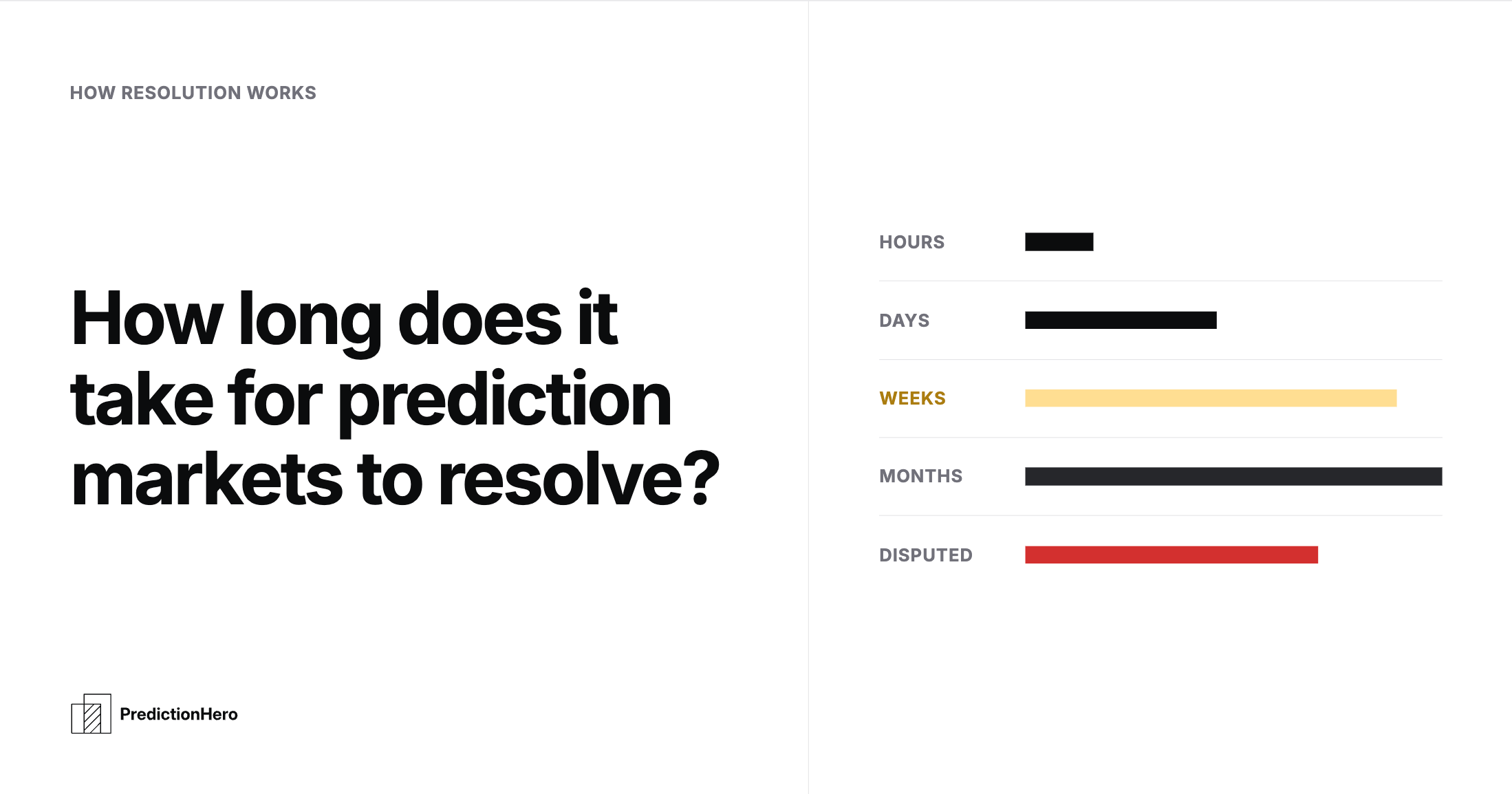
How Long Does It Take for Prediction Markets to Resolve?
Resolution speed depends on governance, not software. Kalshi confirmed a real Fed decision in eight minutes; Polymarket's identical contract took two hours because its dispute window ran uncontested.
Jared Polites · Aug 5