TOTAL VOLUME:
$140.7b
24H VOL:
$176,618,688
24H TRANSACTIONS:
2,543,053,589
OPEN INTEREST:
$1,606,811,120
418,163
Markets across
32,862
events
MATCHED EVENTS:
2,828
PLATFORM COVERAGE:
5
Polymarket:
39%
VS.
Kalshi:
61%
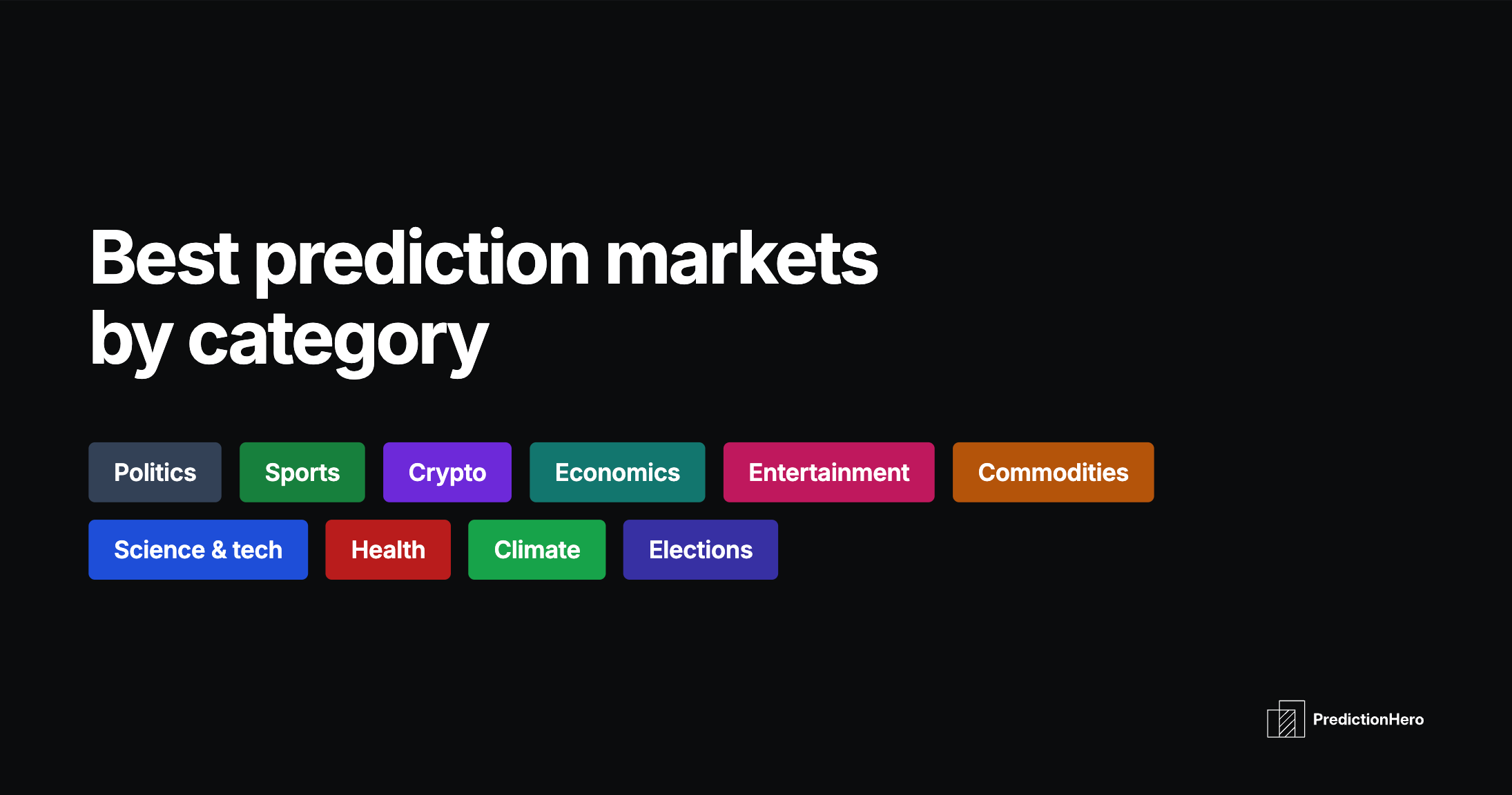
Best Prediction Markets by Category: Where to Look for Politics, Sports, Crypto, and More
There's no single best prediction market. Kalshi, Polymarket, Limitless, Predict.Fun, and Opinion were each built for a different kind of question.

Jared Polites
Aug 22, 2026
TL;DR
- There's no single best prediction market. Kalshi leads on CFTC-regulated US politics and macro data, Polymarket leads on global liquidity and crypto, Limitless leads on fast single-match sports contracts, and Predict.Fun leads on crypto-native events with a yield mechanic no other platform offers.
- Kalshi's US sports access rests on a CFTC-preemption argument that's still being contested in court. A Third Circuit panel backed Kalshi in April 2026, but Nevada, Massachusetts, Tennessee, and Washington have all pushed back with enforcement actions or outright bans.
- Polymarket now runs two products: its original offshore exchange resolved through UMA's oracle process, and a separate, CFTC-licensed Polymarket US arm built on its 2025 acquisition of QCEX.
- Where a platform's biggest market sits this week will change. Why it's built the way it's built, its regulatory status, its funding, its founding focus, generally won't.
Trying to price a Fed rate decision and the odds on your usual app look thin and stale? Or pulled up a UFC card on a political exchange and the spread looks off? You're probably not reading a bad number. You're just checking the wrong platform for that particular question.
Five platforms carry real volume in 2026: Kalshi, Polymarket, Limitless, Predict.Fun, and Opinion. None of them is "the best" across the board, because none of them was built to be. Kalshi exists because of its CFTC status. Limitless exists because its founders optimized for fast-moving, high-frequency sports contracts.
Opinion exists for macro data releases and never touched a football score until years after it launched. Knowing which platform to check first for a given category saves you from digging through a general-purpose exchange when a specialized one already has the deeper market.
This is a structural map, not a leaderboard. Where a platform's biggest market sits this week will change. Why it's built that way won't.
Which Prediction Market Is Best for Politics?
Kalshi exists because of politics. It's a CFTC-regulated exchange, the first of its kind in the US, built specifically to let American retail traders take positions on elections, confirmation votes, and legislative deadlines without touching crypto. If you want a US-compliant read on a domestic political question, Kalshi is where the CFTC framework points you.
Polymarket covers politics too, from a different angle. Its core product runs on a global, crypto-native user base, so its political markets pull in international perspective that a US-only exchange won't capture: foreign elections, geopolitical votes, EU policy outcomes. For a global political question, Polymarket tends to carry the deeper liquidity.
There's now a second option inside Polymarket itself. Its 2025 acquisition of the CFTC-licensed exchange QCEX created a separate, regulated Polymarket US product for domestic traders, alongside the original offshore product that still resolves through UMA's oracle process. Our Kalshi vs. Polymarket comparison breaks down when that regulated US arm is the better fit than Kalshi.
The distinction matters more than it sounds. A domestic US race gets priced by a different pool of traders than a European referendum, and the platform you check should match the geography of the question.
Which Prediction Market Is Best for Sports?
Limitless runs on-chain with its own $LMTS token, and its founding focus was individual match markets rather than season-long outcomes. That means granular, fast-settling contracts: will this team cover, will this player hit a specific stat line, will this match go to overtime.
Its board runs dedicated Korean and Chinese market sections alongside the main one, a real structural signal that its order books draw a meaningfully different regional audience than a US-only exchange does. For in-match or single-event sports questions, Limitless is built for that granularity.
Kalshi's sports presence is newer, and it's a jurisdiction argument, not a volume one. Because Kalshi is CFTC-regulated, it argues federal law preempts state-by-state gambling law, letting it offer sports contracts to US retail traders even in states that restrict standard sports betting.
That argument is still being tested in court. A divided Third Circuit panel sided with Kalshi's CFTC-preemption position in April 2026, but Nevada, Massachusetts, and Tennessee have pressed enforcement actions since, and Washington banned Kalshi's sports contracts outright on August 17, 2026. Check our breakdown of CFTC vs. state regulation for where things stand in your state before assuming Kalshi's sports markets are live where you are.
Polymarket also carries sports markets at scale, largely because its overall liquidity is the deepest of the five platforms. It's less a sports specialist than a place where sports markets benefit from the same crypto-native volume that drives its politics and crypto categories.
Which Prediction Market Is Best for Crypto Events?
Predict.Fun runs on BNB Chain and is backed by YZi Labs, the venture arm formerly known as Binance Labs. That lineage shapes what the platform does well: crypto-native events, token launches, protocol upgrades, exchange listings.
It also does something none of the other four platforms do. Collateral sitting in an open position routes through Venus Protocol on BNB Chain and earns yield while the position stays open. That's a structural design choice for traders who think about capital efficiency, not just outcome probability. For a crypto-specific question, Predict.Fun is purpose-built around that audience.
Polymarket, again, shows up here on the strength of its overall liquidity and crypto-native user base. Bitcoin price brackets, ETF decisions, and protocol governance votes draw real volume on Polymarket because its traders are already fluent in crypto market structure. It's not a crypto specialist by founding mandate the way Predict.Fun is, but its depth makes it a reliable second check.
Which Prediction Market Is Best for Economic Data?
Opinion is the outlier of the five, and that's the point. It wasn't built around sports or politics. It was built for macro trading: FOMC rate decisions, CPI prints, GDP data, and the geopolitical risk that moves rates and currencies.
Its trader base thinks in probabilities across asset classes rather than in win-loss terms, a different mindset than a sports-first platform attracts. For a question about a Fed decision or an inflation print, Opinion is the platform whose founding focus lines up with the question.
Kalshi also carries real weight here, again because of its CFTC status. Economic data releases are exactly the kind of regulated, well-defined event a CFTC-regulated exchange is positioned to list cleanly, and its US retail access gives it a domestic audience that Opinion's more crypto-native base doesn't have.
Why Are Entertainment and Weather Markets Thinner Across All Five Platforms?
Entertainment (award shows, box office results, reality TV outcomes) and weather (storm paths, temperature thresholds, seasonal forecasts) aren't any of the five platforms' founding focus. They show up as secondary categories, usually on whichever platform has the broadest overall catalog at a given moment. Today that tends to be Polymarket or Kalshi.
Neither category has a platform built around it the way politics has Kalshi or crypto has Predict.Fun. If you're researching an entertainment or weather question, expect thinner liquidity across the board and check more than one platform before treating a single price as representative.
How Do the Five Platforms Actually Compare?
| Platform | Regulatory Status | Funding | Founding Focus | US Retail Access |
|---|---|---|---|---|
| Polymarket | Core product operates offshore; Polymarket US is CFTC-licensed via the 2025 QCEX acquisition | Crypto collateral (USDC) | Broad, global, crypto-native | Yes, through the separate Polymarket US product |
| Kalshi | CFTC-regulated exchange | Bank transfer (USD) | Politics and macro economics | Yes, direct |
| Limitless | On-chain, outside US exchange registration | Crypto (on-chain) | Sports, individual match markets | Yes, crypto-based access |
| Predict.Fun | On-chain (BNB Chain), backed by YZi Labs | Crypto collateral, yield-bearing via Venus Protocol | Crypto-native events | Yes, crypto-based access |
| Opinion | On-chain, outside US exchange registration | Crypto collateral | Macro economics: FOMC, CPI, GDP | Yes, crypto-based access |
A table like this stays useful over time because it describes what each platform is, not what any one contract is priced at today. Live spreads change by the hour. Regulatory status and founding focus don't move nearly as often, though as the Kalshi sports fight above shows, "regulatory status" itself can shift inside a single quarter.
A Yes contract on any of these five platforms pays $1 if the outcome resolves correctly and $0 if it doesn't. The two sides of a binary market sum to roughly $1.00 before fees, regardless of which platform lists it. That mechanic is constant. What differs is who's trading, what they're regulated to offer, and which category they built their infrastructure around.
If you're new to how these contracts work in the first place, our prediction markets explainer covers the basics, and Kalshi's own legitimacy record is worth a look if regulatory status is what you're weighing most. PredictionHero's own trending markets view shows all five platforms side by side on one screen, so you're not checking five tabs to answer one question.
Frequently asked questions
Kalshi for US-specific questions, since its CFTC-regulated structure gives it direct retail access and a domestic trader base. Polymarket for international questions, on the strength of its global liquidity, plus its newer Polymarket US product for a second regulated domestic option.
Limitless for granular, single-match contracts, built around fast-settling individual event markets. Kalshi offers sports access through a CFTC-preemption argument that courts are still actively deciding; several states pushed back with bans or cease-and-desists in 2026, so check availability in your state first.
Predict.Fun, built on BNB Chain and backed by YZi Labs, with a founding focus on crypto-native events and a yield mechanic on open collateral. Polymarket is a strong second check given its overall depth.
Opinion, built specifically around FOMC decisions, CPI prints, and GDP data. Kalshi is a close second thanks to its CFTC status and US audience.
Yes. Identical events can trade at different implied probabilities across venues because each platform draws a different trader base. Comparing across all five, Polymarket, Kalshi, Limitless, Predict.Fun, and Opinion, is the only way to see the full picture rather than one audience's read on it.
PredictionHero aggregates data across Polymarket, Kalshi, Limitless, Predict.Fun, and Opinion so the right platform for a given category is visible in one place instead of five open tabs.
Sources
- KalshiEX LLC DCM Rulebook, filed with the CFTC. cftc.gov
- PR Newswire. "Polymarket Acquires CFTC-Licensed Exchange and Clearinghouse QCEX for $112 Million." prnewswire.com
- Paul, Weiss. "A Divided Third Circuit Holds That the CFTC Has Exclusive Jurisdiction Over Sports-Related Event Contracts." paulweiss.com
- Tech Times. "Washington Bans Kalshi Sports Contracts; Financial Data Markets Survive Court Test." techtimes.com
- CryptoBriefing. "Predict.fun Lands YZi Labs and Susquehanna Crypto Investment to Scale BNB Chain Prediction Markets." cryptobriefing.com
- ETF.com. "Limitless Prediction Market Closes $10M Seed Round Ahead of LMTS Token Launch." etf.com
PredictionHero aggregates publicly available prediction market data for informational purposes only. This is not financial advice. Prediction markets may not be available in all jurisdictions.
Related
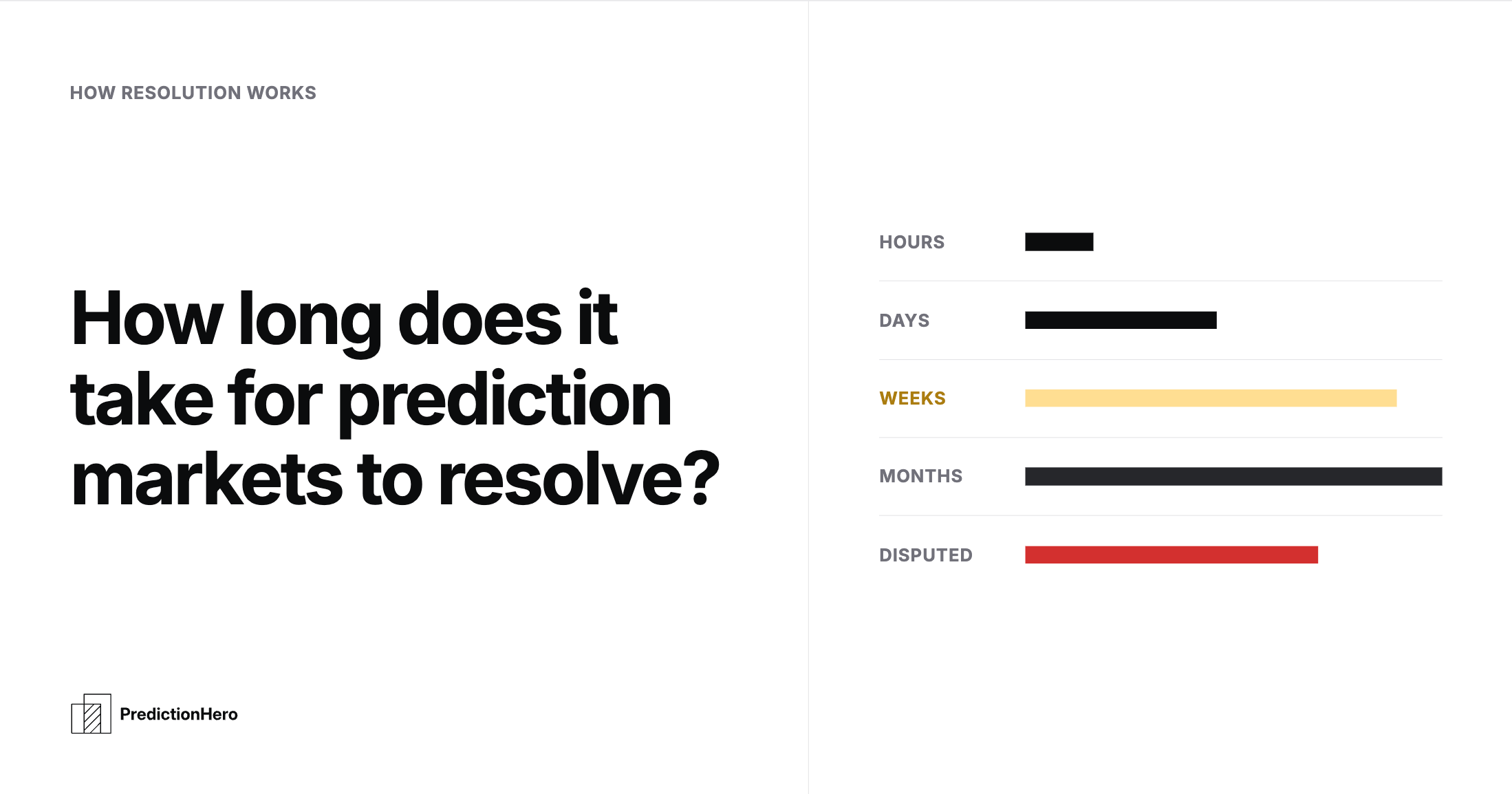
How Long Does It Take for Prediction Markets to Resolve?
Resolution speed depends on governance, not software. Kalshi confirmed a real Fed decision in eight minutes; Polymarket's identical contract took two hours because its dispute window ran uncontested.
Jared Polites · Aug 5

How to Use Polymarket in the US (Legal Status, Setup, and a Safer Path)
Polymarket now runs a CFTC-regulated US product through its QCX exchange. Here's how it actually works, who's eligible, and when Kalshi is the better fit instead.
Jared Polites · Aug 14
What Are Prediction Markets? How They Actually Work
Prediction markets price real-world events the way markets price stocks. See how they work, and compare live odds across all 5 major platforms.
Jared Polites · Jul 10