TOTAL VOLUME:
$133.6b
24H VOL:
$92,851,721
24H TRANSACTIONS:
2,371,557,760
OPEN INTEREST:
$1,376,165,751
370,286
Markets across
29,142
events
MATCHED EVENTS:
2,555
PLATFORM COVERAGE:
5
Polymarket:
40%
VS.
Kalshi:
60%
What Is Opinion (Opinion.Trade)? Inside the AI-Oracle Prediction Market
Opinion (opinion.trade) is a BNB Chain prediction market that resolves most of its contracts through an AI system called Opinion AI, backed by a token-staked dispute window.

Jared Polites
Sep 18, 2026
TL;DR
- Opinion (opinion.trade, traded through app.opinion.trade) is a BNB Chain prediction market where most contracts resolve through an AI system called Opinion AI, not a human desk or a token-holder vote.
- Anyone who disagrees with a resolution can dispute it by staking Opinion's own token, $OPN; win the dispute and you get double your stake back, lose it and the stake is forfeited.
- Its market list spans both macro contracts (FOMC, CPI, GDP) and sports/culture events like the World Cup, not one category exclusively.
- Opinion runs a standard maker/taker order book like Kalshi, Polymarket, and Predict.Fun, charging takers 0% to 1% and makers nothing, but its own terms currently block trading access from the US, UK, France, and several other countries.
Come across a market called "FOMC decision probability" sitting one tap away from a World Cup outcome contract, and wonder what platform mixes the two? That's Opinion (opinion.trade, run through app.opinion.trade), a prediction market built on BNB Chain. You connect a crypto wallet or log in with a Google or X account, trade the same $0-to-$1 Yes/No contracts you'd find on Kalshi or Polymarket, and Opinion's own AI system resolves most of them once the outcome is known.
The bigger structural difference between Opinion and the other four platforms PredictionHero tracks, Polymarket, Kalshi, Limitless, and Predict.Fun, isn't what the app looks like. It's what happens after a market closes, and who Opinion currently lets in the door to trade it at all.
How Does an Opinion Contract Actually Price a Market?
Every Opinion contract works the way every contract on the other four platforms does. A Yes share settles at $1 if the outcome happens and $0 if it doesn't, and the live price in between is the crowd's running estimate of the probability.
Say a contract on "will the Fed cut rates this quarter" trades at $0.35. That's the market pricing a 35% chance, built from real positions rather than a poll or a pundit's guess.
Structurally, Opinion prices its markets through a standard maker/taker order book, the same mechanism Kalshi, Polymarket, and Predict.Fun use. None of the four runs on an automated market maker, despite Opinion's crypto-native reputation suggesting otherwise. Limitless is the one platform among the five that still runs a genuine AMM, layered alongside its own order book for short-duration hourly and daily contracts.
Does Opinion Focus on Macro Markets or Culture, or Both?
Opinion's own foundational materials lean heavily toward macroeconomics. Its documentation describes the platform as building "the People's Terminal for Global Economic Trading," with worked examples built around Fed rate decisions, CPI prints, and a hedge fund hedging CPI exposure directly on the platform.
Its live product tells a broader story. Opinion's own educational blog runs a dedicated World Cup section and a separate esports guide covering Dota 2, Counter-Strike, and League of Legends, and one of Opinion's own posts describes the platform outright as "sports-first."
Read both together and the honest answer is that Opinion runs both lanes rather than picking one. It launched with an institutional, macro-first pitch and has since built out the same culturally reactive sports and entertainment coverage that Kalshi and Polymarket also carry. That combination, an institutional core with a genuinely broad category list on top, is closer to what actually differentiates Opinion than any claim about its interface.
How Does Opinion Resolve a Market? What Is "Opinion AI"?
This is the part of Opinion's design that's genuinely unlike the other four platforms.
Kalshi resolves its contracts through an internal compliance process under CFTC oversight. Polymarket resolves disputed markets through UMA's optimistic oracle, where token holders vote on the correct outcome if a resolution gets challenged. Opinion instead resolves "most markets," per its own documentation, through an AI system it calls Opinion AI, described as "the first decentralized multi-agent AI oracle capable of resolving complex, unstructured data."
If a trader disagrees with a resolution, Opinion opens a dispute window, typically two hours (longer for some asset-price contracts), during which anyone can challenge the call by staking $OPN. The stake has to be at least 1,000 $OPN or 1% of the market's open interest, whichever is larger. Win the dispute and Opinion returns double the stake. Lose it, and the stake is forfeited.
Opinion's own team has publicly floated a future hybrid model layering trusted execution environments and human review on top of the AI oracle. Its current public documentation doesn't yet describe that hybrid layer as fully operational, so treat it as a stated direction rather than how resolution works today.
None of these three approaches, an AI oracle with staked disputes, a token-holder vote, or an internal compliance desk, is objectively the right way to keep a prediction market honest. Each is a different bet on how to combine speed, decentralization, and accountability. Opinion's version is one of the more novel experiments in that specific design space among the platforms PredictionHero covers.
Is Opinion a Mobile App, or Is That the Wrong Way to Think About It?
Opinion trades through a single web address, app.opinion.trade, reached from a browser. Its own directory of official links lists the trading app, its docs, its blog, a GitHub, and a token-foundation site. No App Store or Google Play listing appears anywhere in that list, so based on what Opinion itself publishes, there's no confirmed native mobile app to point to.
Opening an account doesn't require an ID upload, at least not as a documented step. You either connect a supported wallet (Opinion lists Binance Wallet, OKX Wallet, MetaMask, Backpack, and Coinbase Wallet) or sign in with a Google or X account. Opinion's terms require you to self-attest that you're 18 or older and not located in a restricted jurisdiction, and reserve the right to ask for more information later.
One claim worth being straightforward about: a scrollable market feed with comment threads on individual markets isn't documented anywhere in Opinion's own docs or blog as of this check. That doesn't mean it isn't in the live app. It means it isn't something Opinion itself has published, so it isn't a fact this article can stand behind either way without someone checking the live product directly.
Where Can You Actually Use Opinion?
This is the access question that matters more than interface design, and it's the one place Opinion looks meaningfully different from the other four platforms in this comparison.
Opinion's terms of use, last updated October 19, 2025, block trading access from a specific list of countries: the United States, the United Kingdom, France, Ontario, Singapore, Poland, Thailand, South Korea, mainland China, Taiwan, and Hong Kong, on top of the standard US-sanctioned jurisdictions like Iran, Syria, Cuba, and North Korea. Using a VPN to get around that list is explicitly against Opinion's terms.
Someone browsing from a restricted country can still view Opinion's market pages and news content. Placing an actual trade is the part that's blocked.
That's a real structural trade-off, not a flaw unique to Opinion. Kalshi solves the same problem by staying inside US federal regulation and accepting that its access is domestic-first. Opinion solves it by building for a global, wallet-first audience and excluding a specific set of jurisdictions by name in its own terms, a different starting point from the international-vs-KYC'd split you'll find if you check our KYC comparison across all five platforms. Check the list directly against your own location before assuming Opinion is available to you, since compliance lists like this one get updated.
What Do Opinion's Fees Actually Cost?
Opinion charges takers only. Makers, meaning resting limit orders that add to the order book rather than filling immediately, pay $0.
The taker fee runs between 0% and 1%, set per market by a topic-specific rate that Opinion multiplies against the same price-times-one-minus-price curve every order-book platform in this space uses. A contract sitting at 50 cents, the point of maximum uncertainty, pays the highest fee within that market's own range. A contract near 5 cents or 95 cents pays close to nothing. Every order carries a $5 minimum and a $0.25 minimum fee regardless of the math.
That shape isn't unique to Opinion. Kalshi runs a similar price-times-one-minus-price formula on its own published fee schedule (see our Kalshi fee breakdown for the exact coefficient), and Polymarket charges takers a category-based rate on the identical curve: 0.04 for politics and finance, 0.05 for sports and culture, 0.07 for crypto, with geopolitical and world-event markets fee-free (see the numbers side by side in our Polymarket vs Kalshi comparison). Limitless is the one platform of the five that breaks from this shape, charging a flat rate on the AMM-priced contracts it runs alongside its order book. Opinion also pays referrers 5% of whatever fee their invitees generate, a smaller version of the referral and rebate programs Polymarket and Kalshi both run.
Who's Behind Opinion?
Opinion's terms of use name the operating company as Superchillclub Limited, governed under Panama law. The public-facing brand across its GitHub and social accounts is "Opinion Labs," and a separate domain, opinion.foundation, handles matters tied to the $OPN token. Opinion's own materials don't spell out exactly how those three names relate to each other corporately.
The money behind it traces to some of the bigger names in crypto venture. Binance Labs made a strategic investment in August 2024, before it was renamed YZi Labs. YZi Labs then led a $5 million seed round in March 2025 alongside Echo, Animoca Ventures, Manifold Trading, and Amber Group. A $20 million pre-Series A followed in February 2026, backed by Hack VC, Jump Crypto, Primitive Ventures, and Decasonic. That's roughly $25 million in disclosed funding across two priced rounds, on top of the earlier Binance Labs stake.
Where Opinion Sits Among the Five Platforms
| Platform | Underlying Chain | Access Model | Resolution Mechanism | Notable Structural Trait |
|---|---|---|---|---|
| Polymarket | Polygon (an Ethereum layer-2) | Wallet, global (international product); separate KYC'd Polymarket US | UMA optimistic oracle, token-holder dispute vote | Maker rebate program; deepest liquidity of the five |
| Kalshi | None (centralized, not on-chain) | US retail, bank transfer | Internal compliance review under CFTC oversight | Federal preemption fight over sports contracts |
| Limitless | Base | Wallet, global | Not publicly detailed to the same depth as Opinion or Polymarket | Hybrid order book plus AMM for short-duration contracts; $LMTS token |
| Predict.Fun | BNB Chain | Wallet, global | Not publicly detailed to the same depth as Opinion or Polymarket | Idle collateral earns yield through Venus Protocol |
| Opinion | BNB Chain | Wallet or Google/X login, web-based; blocked in the US, UK, and several other countries | AI oracle ("Opinion AI") plus $OPN-staked dispute window | Macro contracts (FOMC, CPI) alongside sports and culture markets like the World Cup |
Durable structural differences like these, not live prices, are what actually separate one platform from another over time. Fees, volume, and odds shift by the hour. Chain, access rules, and how a platform resolves a dispute don't change nearly as often.
Why Does Opinion's Resolution Model Matter for Traders?
A prediction market's price is only as trustworthy as the process that eventually settles it. If a platform's resolution process is slow, opaque, or easy to game, the price leading up to it means less, no matter how liquid the market looks.
Opinion's AI-oracle-plus-staked-dispute model is a genuinely different answer to that problem than Polymarket's token-holder vote or Kalshi's compliance desk. Staking a real token to challenge a result gives disputers a financial reason to only challenge calls they're confident about, since a rejected dispute costs them the stake. Winning a dispute pays double, which gives good-faith challengers a real incentive to actually use the mechanism rather than let a bad call stand.
Whether that holds up as well as UMA's more battle-tested voting system or a CFTC-regulated compliance process is genuinely untested at scale. Opinion's approach is newer and has settled far fewer disputes than either of the other two. That's not a knock on the design. It's simply where the industry currently stands: several credible approaches to the same problem, each with a different amount of track record behind it, and Opinion's is one worth watching rather than dismissing.
Explore live Opinion markets directly, keeping the access restrictions above in mind before you try to fund an account.
The Five Platforms, One Dashboard
PredictionHero aggregates and normalizes markets across Polymarket, Kalshi, Limitless, Predict.Fun, and Opinion, so you can see how the same event prices across a CFTC-regulated exchange, an AI-resolved order book, and everything in between without opening five different apps or five different wallets.
Frequently asked questions
Opinion.trade is a BNB Chain prediction market where users trade Yes/No contracts on real-world events, from Fed rate decisions to sports and entertainment outcomes. It's reached through a web app at app.opinion.trade rather than a documented native mobile app, and most of its markets resolve through an AI system called Opinion AI.
Most Opinion markets resolve through Opinion AI, an automated multi-agent oracle system. Anyone who disagrees with a result can dispute it during a window, typically two hours, by staking Opinion's $OPN token. A successful dispute returns double the stake; an unsuccessful one forfeits it.
No. Opinion's terms of use block trading access from the US, the UK, France, and several other countries, alongside standard US-sanctioned jurisdictions. Users in those countries can view market pages but can't place trades, and using a VPN to bypass the restriction violates Opinion's own terms.
Yes. Opinion's token is $OPN, used mainly to stake disputes against market resolutions. Opinion's own materials are explicit that $OPN isn't an equity stake in the company.
Both macro and cultural events. Opinion's founding materials frame it around institutional-style economic contracts like FOMC rate decisions, CPI, and GDP, while its own blog shows heavy coverage of sports and entertainment markets, including a dedicated World Cup section and esports contracts.
All three charge takers a fee that peaks around a 50-cent contract and shrinks toward the extremes, just with different rates: Opinion's runs 0% to 1% depending on the market, Polymarket's runs 0.04 to 0.07 depending on category, and Kalshi publishes its own coefficient on a similar curve. All three charge makers nothing.
Sources
- Opinion Docs. "Welcome to OPINION." docs.opinion.trade
- Opinion Docs. "About OPINION." docs.opinion.trade/about-opinion/about-opinion
- Opinion Docs. "Fees." docs.opinion.trade/trade-on-opinion.trade/fees
- Opinion Docs. "Resolution." docs.opinion.trade/trade-on-opinion.trade/resolution
- Opinion Docs. "Dispute." docs.opinion.trade/trade-on-opinion.trade/dispute
- Opinion Docs. "Connect With Web3 Wallet." docs.opinion.trade/trade-on-opinion.trade/connect-with-web3-wallet
- Opinion Docs. "Terms of Use." Last updated October 19, 2025. docs.opinion.trade/legal/terms-of-use
- Opinion Learn. "Who Backs Opinion: Investors and Supporters." blog.opinion.trade/learn/who-backs-opinion-investors-and-supporters
- Opinion Learn. "How Opinion's AI Oracle Works." blog.opinion.trade/learn/how-opinion-ai-oracle-works
- Opinion Learn. "Opinion Availability and Eligibility." blog.opinion.trade/learn/opinion-availability-and-eligibility
- Opinion Learn. "What Is Opinion Prediction Market." blog.opinion.trade/learn/what-is-opinion-prediction-market
- Polymarket Help Center. "Trading Fees." Updated July 10, 2026. help.polymarket.com/en/articles/13364478-trading-fees
- Kalshi Help Center. "Fees." help.kalshi.com/en/articles/13823805-fees
PredictionHero aggregates publicly available prediction market data for informational purposes only. This is not financial advice. Prediction markets may not be available in all jurisdictions.
Related
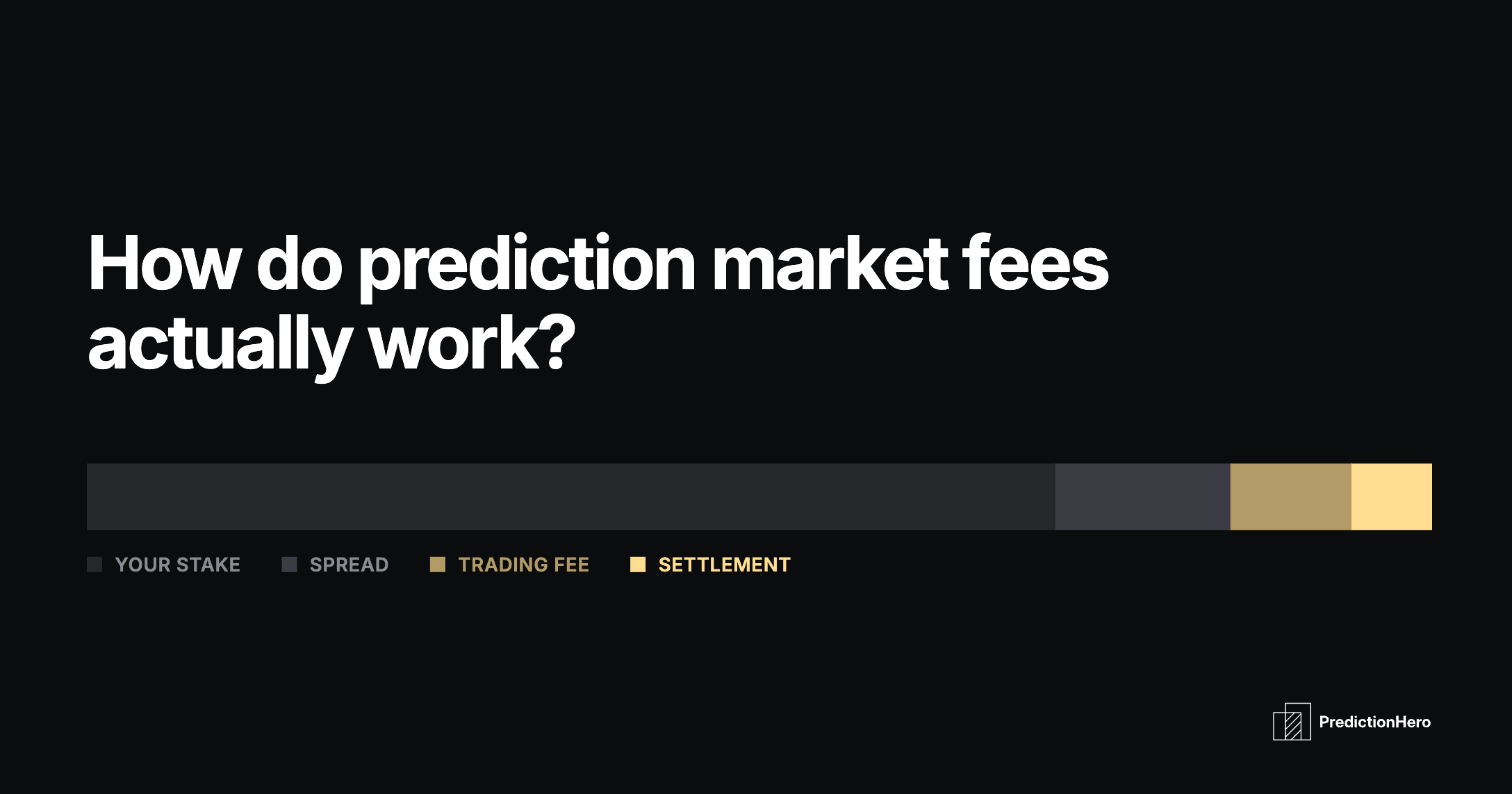
How Do Prediction Market Fees Actually Work?
Kalshi, Polymarket, Predict.Fun, and Opinion now all charge takers a fee that peaks on a 50-cent contract and fades toward the extremes.
Jared Polites · Aug 18
Prediction Market KYC Requirements: What ID You Need on Each Platform
Kalshi requires full ID verification to fund an account. Polymarket, Limitless, Predict.Fun, and Opinion only need a connected crypto wallet, with Polymarket's own US arm as the one exception.
Jared Polites · Sep 17
Kalshi vs Polymarket: Which Prediction Market Is Right for You?
Kalshi is CFTC-regulated and dollar-funded. Polymarket runs on USDC with deeper global liquidity and now has its own regulated US arm too. Compare live.
Jared Polites · Jul 30