TOTAL VOLUME:
$154.8b
24H VOL:
$277,138,640
24H TRANSACTIONS:
2,984,640,614
OPEN INTEREST:
$1,905,404,943
412,077
Markets across
39,838
events
MATCHED EVENTS:
4,526
PLATFORM COVERAGE:
5
Polymarket:
37%
VS.
Kalshi:
63%
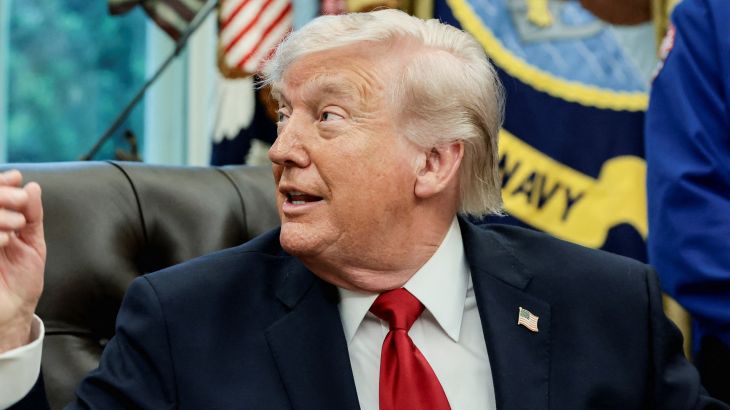
Closed: Oct 1, 4:23 AM EST

Polymarket
Description
This market will resolve to "Yes" if Donald Trump makes any public statement in which he insults the listed individual between market creation and the specified date (ET). Otherwise, this market will resolve to "No". A public statement is any written, verbal, or recorded statement which is either made in a public setting, published by the speaker, or on the record to media, and the direct language of which is made publicly available within the specified timeframe. Pre-recorded public statements will count for the date (ET) that they are made publicly available. Statements made in private that are subsequently leaked will not qualify, even if credibly reported. Narrations and paraphrasings do not qualify. Images and videos posted on verified social media accounts will only qualify if they contain insulting language clearly directed at the individual, whether within the content itself or in an accompanying caption. Language within the content of a video will only qualify if Donald Trump is clearly portrayed as saying it. Insulting language within the content of a video said by anyone other than Donald Trump or a portrayal thereof will not qualify. A quote post will qualify if added language independently qualifies as an insult, or endorses insulting language directed at the individual within the quoted post; a repost of another account's post will not qualify. A public statement qualifies as an insult if it mocks, degrades, or disparages the individual either personally or professionally. This includes calling the individual a clearly insulting trait (e.g., weak, stupid, disloyal, a failure), using an insulting nickname (e.g., Crooked Hillary), using other clearly derogatory language, or using the negative form of a positive trait in a clearly derogatory manner (e.g., “He isn’t smart”, “He has no judgment”). Disparaging the individual in their professional capacity will qualify (e.g., "He is a disaster candidate," "He is terrible at his job"); however, negative comments directed at the individual's specific actions, policies, or decisions will not qualify (e.g., "He has bad policies," "He is wrong about healthcare"). A statement made in direct reference to the individual will qualify even if they are not named, so long as it is reasonably clear from context that they are the subject. The resolution sources will be public statements made by Donald Trump and a consensus of credible reporting.
Polymarket
This market will resolve to "Yes" if Donald Trump makes any public statement in which he insults the listed individual between market creation and the specified date (ET). Otherwise, this market will resolve to "No". A public statement is any written, verbal, or recorded statement which is either made in a public setting, published by the speaker, or on the record to media, and the direct language of which is made publicly available within the specified timeframe. Pre-recorded public statements will count for the date (ET) that they are made publicly available. Statements made in private that are subsequently leaked will not qualify, even if credibly reported. Narrations and paraphrasings do not qualify. Images and videos posted on verified social media accounts will only qualify if they contain insulting language clearly directed at the individual, whether within the content itself or in an accompanying caption. Language within the content of a video will only qualify if Donald Trump is clearly portrayed as saying it. Insulting language within the content of a video said by anyone other than Donald Trump or a portrayal thereof will not qualify. A quote post will qualify if added language independently qualifies as an insult, or endorses insulting language directed at the individual within the quoted post; a repost of another account's post will not qualify. A public statement qualifies as an insult if it mocks, degrades, or disparages the individual either personally or professionally. This includes calling the individual a clearly insulting trait (e.g., weak, stupid, disloyal, a failure), using an insulting nickname (e.g., Crooked Hillary), using other clearly derogatory language, or using the negative form of a positive trait in a clearly derogatory manner (e.g., “He isn’t smart”, “He has no judgment”). Disparaging the individual in their professional capacity will qualify (e.g., "He is a disaster candidate," "He is terrible at his job"); however, negative comments directed at the individual's specific actions, policies, or decisions will not qualify (e.g., "He has bad policies," "He is wrong about healthcare"). A statement made in direct reference to the individual will qualify even if they are not named, so long as it is reasonably clear from context that they are the subject. The resolution sources will be public statements made by Donald Trump and a consensus of credible reporting.
Frequently asked questions
On Polymarket, this market is priced using a continuous double auction. Traders buy and sell shares representing their belief in whether Donald Trump will publicly insult a specific person by the resolution date. As more people buy shares in a particular outcome, the price increases, reflecting a higher probability. Conversely, increased selling pressure lowers the price. On Polymarket, prices reflect that venue's order book, liquidity, and how traders price the outcome right now. The price of a 'yes' share represents the probability of that outcome occurring, as perceived by the collective intelligence of the market participants. This dynamic pricing mechanism allows for real-time adjustments based on new information and evolving expectations.
This market resolves around Sep 30, 2026, with the outcome confirmed once the event is verifiable from credible public reporting. Specifically, the resolution will depend on whether Donald Trump makes a public statement that is widely interpreted as an insult directed at a named individual. The determination will rely on documented statements – such as those made on social media, during rallies, or in interviews – and will be assessed based on common understanding of what constitutes an insult. The focus is on clear and direct criticism, not general disagreements or policy debates.
Several factors could significantly shift the odds in this market. Any public feud or escalating tension between Donald Trump and a potential target would likely drive up the probability of an insult. Major news events, political developments, or even social media controversies could also serve as catalysts. Unexpected endorsements or criticisms from Trump could quickly change trader sentiment. Furthermore, shifts in the broader political landscape and the approach of Sep 30, 2026 itself will likely increase trading activity and price volatility as traders refine their predictions.
