TOTAL VOLUME:
$147.7b
24H VOL:
$133,465,234
24H TRANSACTIONS:
2,799,919,006
OPEN INTEREST:
$1,789,144,443
499,910
Markets across
37,496
events
MATCHED EVENTS:
2,829
PLATFORM COVERAGE:
5
Polymarket:
38%
VS.
Kalshi:
62%
World Cup 2026 Winner Odds: What Prediction Markets Are Saying
France and Spain are the co-favorites, but no team is above 18%. Here's what five prediction markets are currently pricing as the most likely winner — and where they disagree.
Jun 11, 2026

The 2026 FIFA World Cup kicks off today, June 11. Here's what prediction markets on Polymarket, Kalshi, and Predict are currently pricing as the most likely winner and where they disagree.
Current Favorites
The market hasn't crowned anyone. Spain leads the field at a 17.22% consensus across the three platforms, with France a single point behind at 16.25%. Neither number should be read as confidence. Over the last seven World Cups, the pre-tournament favorite won exactly three times. The other four were taken by teams who entered as second or third choice. At today's prices, Spain is essentially a coin flip to reach the final and something like a 1-in-6 shot to win the whole thing. That's the ceiling, not the floor.
Here's where things stand as of June 11, 2026, with combined group volume already past $2.4 billion:
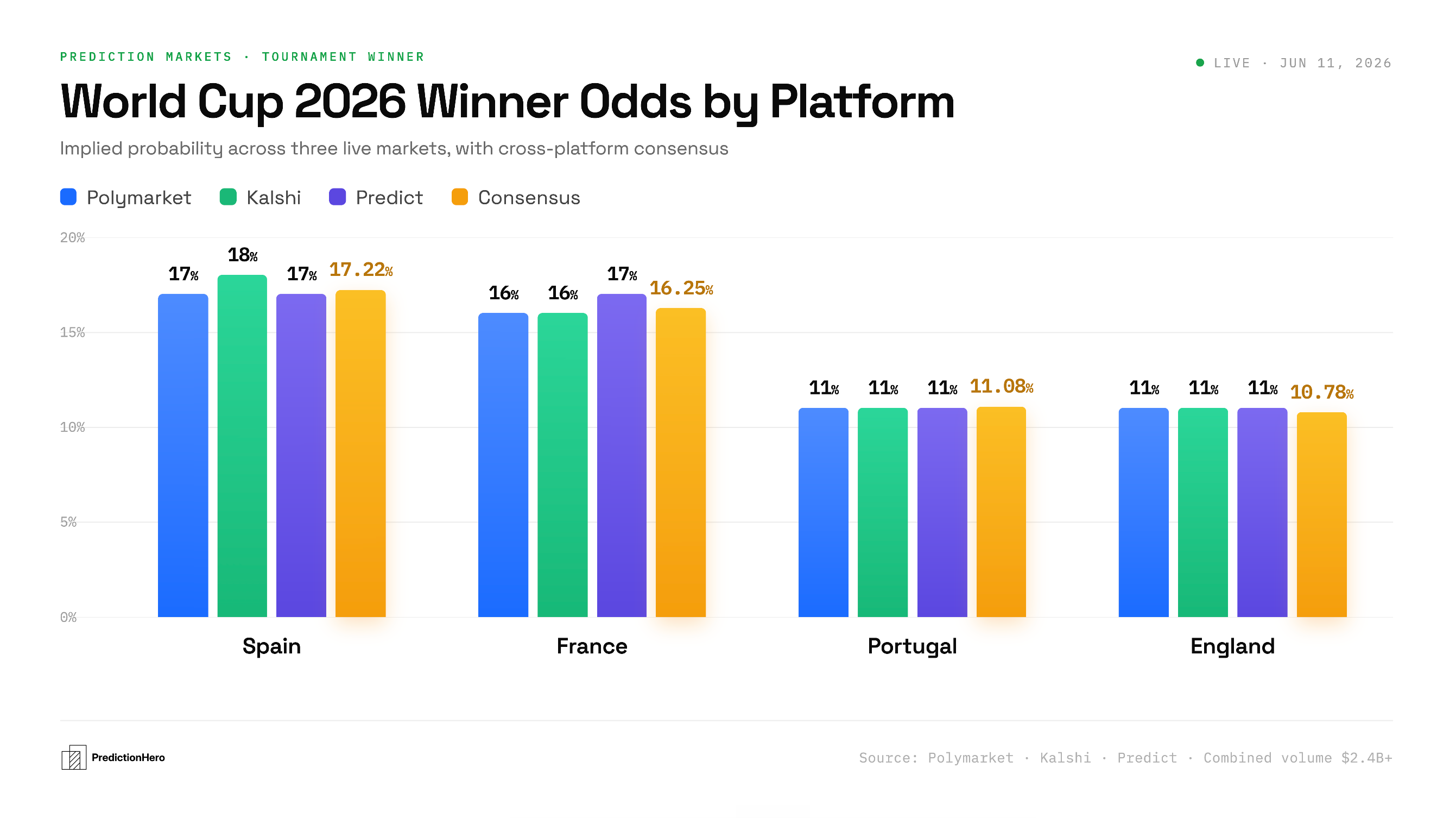
Odds update continuously. Check the live event page for current pricing.
Spain's case is structural. Reigning European champion, a midfield axis in Rodri and Pedri that no other team can match, and the kind of ball retention that suffocates opponents over 90 minutes. The market reflects it: Spain's winner contract carries the deepest single-team liquidity in the field, over $6 million on the highest-volume platform alone, which is a signal in itself. Traders don't put that kind of money behind a team they consider a sentimental pick.
France sits just behind, and the gap between the two is the most interesting argument in this market. France was the betting favorite as recently as April before Spain overtook them. The case for France is individual brilliance, Mbappe as a player who can decide a knockout match by himself. The case for Spain is that tournaments are won by systems, not moments. The market is currently siding with the system, but only just.
Portugal at 11% is the surprise of the board. This isn't a team most casual observers would place third, yet the money does. Portugal pulled ahead of England in consensus pricing over the past week, and on the highest-volume platform its 24-hour activity outpaced nearly every team in the field except the two favorites. Something is moving there, and it's worth paying attention to.
England, also at roughly 11%, has quietly become a team these markets take seriously. Three consecutive major final appearances, Euro 2020, Euro 2024, and the World Cup semifinal in Qatar, don't happen by accident. The Bellingham generation is peaking at the right moment. Markets are no longer pricing England as a romantic long shot. They're pricing them as a genuine top-four team.
Argentina and Brazil round out the contenders, both hovering near 9%. Argentina brings back essentially the same squad that won in Qatar, but defending a World Cup title is one of the hardest things in football. Only Brazil (1958, 1962) and Italy (1934, 1938) have ever done it in back-to-back tournaments. Ancelotti's Brazil, meanwhile, has traded the free-flowing chaos of recent cycles for structure, and the market hasn't fully decided whether that's an upgrade.
Where the Platforms Disagree
Most of the time, Polymarket, Kalshi, and Predict track each other closely on the big names. Spain, France, Portugal, and England are essentially in lockstep across all three. But the small gaps are where the story lives.
Spain shows the clearest split at the top. Kalshi prices Spain at 18%, a full point above both Polymarket and Predict at 17%. Kalshi is a U.S.-regulated exchange with a domestic user base, and that audience has leaned into Spain as the European favorite slightly harder than the global crypto-native traders on the other two platforms. A one-point gap on the tournament favorite, backed by millions in volume on each side, is not noise.
Brazil diverges in the other direction. Polymarket and Kalshi both hold Brazil at 9%, while Predict prices them a point lower at 8%. Predict's trader base skews toward a different regional audience, and the slightly softer read on Brazil reflects it. When a team is priced consistently lower on one venue than the other two, that venue's crowd is usually telling you something about how it weighs that team's actual form versus its reputation.
The rest of the top tier moves together. When all three platforms agree to the decimal, as they nearly do on France and Portugal, that consensus is about as strong a signal as prediction markets produce.
Dark Horses
Two teams in the 4 to 6% range are worth a longer look than their odds suggest.
Germany (around 5.5%) is the classic underpriced tournament side. Four-time world champions, and a team whose entire footballing identity is built on showing up when it matters regardless of how the qualifying campaign looked. The market has them seventh, which on paper feels low for a nation with this pedigree. The 24-hour volume on Germany's winner contract has been climbing, with one platform showing a 76% jump in trading activity, which often precedes a price move. If you believe tournament experience compounds in knockout football, Germany at 5.5% is the value play on this board.
Netherlands (around 4.5%) carry one of the strangest records in the sport: three World Cup finals, zero trophies. The losses tell the story. 1974 to West Germany, 1978 to Argentina on home soil, 2010 to an Iniesta extra-time goal for Spain. If there's a team with structural bad luck baked into its history, it's the Dutch. At 4.5%, the market is discounting them for it. But Van Dijk, Gravenberch, and Gakpo make this a legitimate semi-final roster, and the open interest on the Netherlands contract, over $6 million on the deepest platform, says serious money is positioned for a deep run.
Which Prediction Markets Cover the World Cup
PredictionHero aggregates data from multiple platforms for this event. They are not the same product. Each attracts a different type of trader, operates under different rules, and prices the same event differently as a result. The source of an odds figure matters as much as the figure itself. Each platform's prediction market data reflects its own trader base.
Polymarket is the largest prediction market in the world by volume. Across the World Cup winner markets it carries the deepest liquidity and the heaviest 24-hour activity of any platform in the field. Its user base is global and crypto-native, which means international teams, particularly European ones, tend to be priced with precision. If you see a divergence between Polymarket and anywhere else, the default assumption should be that Polymarket's crowd has the sharper read on cross-border football form.
Kalshi is the first CFTC-regulated prediction exchange in the United States, which matters for two reasons. It's accessible to retail American traders without crypto setup, and that domestic audience skews pricing on teams with strong American name recognition. Its one-point premium on Spain is a live example. Kalshi has built the deepest regulated market coverage of any platform.
Predict (Predict.Fun) is built on BNB Chain and backed by YZi Labs, formerly Binance Labs. It does something no other platform in this group does: collateral deposited into active positions earns yield while the position sits open. That mechanic attracts traders who think about capital efficiency as much as outcome probability, a distinct psychology that shows up in the pricing, including its slightly softer read on Brazil. The platform crossed $1.7 billion in volume since launching in late 2025.
Limitless Exchange runs on-chain with its own $LMTS token, and its World Cup coverage goes deep on individual match markets. Its user base has a notable concentration of Korean and Chinese traders, which shows up in how certain Asian teams are priced relative to Western platforms. PredictionHero sources match-level and group-stage data from Limitless to round out the picture beyond the outright winner market. Its match markets add more prediction market data than the outright winner market alone.
Opinion (opinion.trade) was built for macro economic trading: FOMC decisions, CPI prints, GDP data, geopolitical risk. Sports markets sit alongside that focus rather than leading it. Opinion processes billions in monthly volume, and its trader base thinks in probabilities across asset classes, which makes its pricing on tournament-level events a useful cross-check against the pure sports-trader consensus elsewhere. It prices differently because it attracts different people.
When the platforms agree on a number, that's a signal. When they split, that's a story worth reading.
FAQ
Who are the favorites to win the 2026 World Cup? Spain leads on consensus pricing at roughly 17%, with France close behind at 16%. Portugal and England follow at around 11% each, then Argentina and Brazil near 9%. The expanded 48-team format means the winner plays eight matches to lift the trophy, two more than any previous champion has had to win.
What do prediction markets say about the World Cup? Spain and France lead, but neither is above 18%. The market collectively puts an 80%+ probability of someone else winning, which lines up with history: the pre-tournament favorite has won only three of the last seven World Cups. With combined trading volume already past $2.4 billion, the platforms are pricing this tournament as genuinely wide open.
Are Polymarket, Kalshi, and Predict odds different for the World Cup? On the biggest names they're nearly identical. The divergences are small but real. Kalshi prices Spain a point higher than the other two, likely because of its U.S. user base, while Predict prices Brazil a point lower. PredictionHero tracks these gaps across all platforms in real time. Compare prediction market data across all five rather than reading one outright price.
How accurate are prediction market odds for soccer? Strong on binary questions: will a team qualify, will a specific result happen. Harder on outright tournament winners, where the pre-tournament favorite has won once in the last six editions. The real value isn't in the absolute number. It's in comparing platforms and finding where the crowd is split.
Track live World Cup 2026 odds from Polymarket, Kalshi, Predict, Limitless, and Opinion, updated in real time, on PredictionHero's World Cup event page.
Related
NBA Awards Odds 2026: DPOY, Coach of the Year and MVP
How to read NBA DPOY odds, Coach of the Year odds and NBA MVP odds on prediction markets, and why the 65-game rule and a season-long clock change the price.

Jared Polites · Oct 22

Prediction Markets vs Sportsbooks: What Actually Changes When You Trade an Event Contract
Here's exactly what changes when you trade a Kalshi or Polymarket event contract instead of betting a sportsbook line.
Jared Polites · Aug 27

World Cup 2026 Week 1 Recap: What the Markets Got Wrong (and Right)
France overtook Spain, the USA won its group, and Messi tied a record. How five prediction markets repriced after Week 1.
Jared Polites · Jun 20